Showing posts with label welfare state. Show all posts

Saturday, April 19, 2008

Gordon Brown Wants 'Next' Democratic President to Submit America's Unique Constitution and National Sovereignty to Global Governance (UN/EU) Override

http://news.bbc.co.uk/2/hi/uk_news/politics/7353824.stm


[READERS SHOULD NOTE THAT UK PRIME MINISTER GORDON BROWN HAS ALREADY GIVEN AWAY TO THE EUROPEAN UNION ANCHORED IN BRUSSELS, WITHOUT POPULAR DEMOCRATIC PUBLIC SUPPORT (e.g., A PUBLIC REFERENDUM) THE NATIONAL LEGAL, ECONOMIC AND POLITICAL SYSTEMS, AND THUS, THE NATIONAL SOVEREIGNTY, OF THE UNITED KINGDOM. NOW HE WANTS THE UNITED STATES TO DO THE SAME...]
See: UK Labor Party Willing to Give-Away Country's Sovereignty to EU; Does the US Democratic Party Wish to Do the Same for America??, at: http://itssdpathologicalcommunalism.blogspot.com/2008/04/uk-labor-party-willing-to-give-away.html


Prime Minister Gordon Brown has urged a "new dawn" in co-operation between Europe and the US

All European leaders could work with the US to forge "stronger transatlantic links", he said in a speech in Boston on the last day of his US trip.


He urged them to work together to reform institutions like the UN, World Bank and International Monetary Fund.


They needed reforming to meet modern challenges, he told an audience at the John F Kennedy Presidential Library.

The tantalising possibilities of a world where as John F Kennedy put it, the strong are just, the weak secure and the peace preserved are matched only by the terrifying risks of us failing to seize this moment


Gordon Brown


Mr Brown, who is said to be angry that his trip to the US has been overshadowed by rows at home over his tax reforms, wants the UN to become more effective in conflict prevention and resolution.


He also wants the IMF to develop as an early warning system to prevent problems like the global credit crunch and the World Bank to acquire a new environmental emphasis.


He said: "Now is an opportunity for an historic effort in co-operation; a new dawn in collaborative action between America and Europe - a new commitment from Europe that I believe all European leaders can work with America to forge stronger transatlantic links.
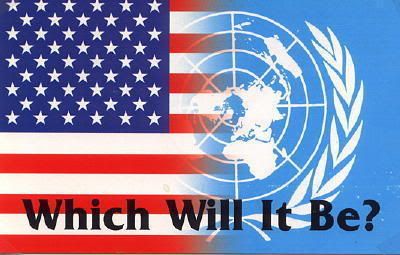
[THIS TALK OF STRENGTHENING TRANS-ATLANTIC LINKAGES IS NOTHING MORE THAN NUANCED CODE LANGUAGE SERVING AS A FALSE PRETENSE JUSTIFYING THE SURRENDER OF U.S. NATIONAL SOVEREIGNTY TO AN ELITIST, COMMUNITARIAN & UNACCOUNTABLE EU/UN GLOBAL LEGAL INFRASTRUCTURE & INSTITUTIONAL BUREAUCRACY OPERATING AT LESS THAN GUARANTEED U.S. CONSTITUTIONAL STANDARDS]


"For I sense common ground between our two great continents in the urgent need for renewal and reform."


'Truly global'


Continuing this theme, he called for "strong regional organisations, building up the African Union as we built up the European Union".


Gordon Brown called for global economic policies that benefit both rich and poor

[THE SHERIFF & TAX COLLECTOR OF DOWNING STREET, IN LONDON, ENGLAND, NOW WISHES TO HELP THE EU COMMISSION SHERIFFS & TAX COLLECTORS SPREAD THROUGHOUT THE STREETS OF BRUSSELS, BELGIUM TO ELEVATE THE UNITED NATIONS TO THE SHERIFFS & TAX COLLECTORS OF PALAIS DES NATIONS, IN GENEVA, SWITZERLAND, SO THAT THEY CAN ASSUME THE ROLE OF A GLOBAL ROBIN HOOD]


Ultimately, he called for established institutions to "bring to a troubled world the humanitarian and peacekeeping and the support for stability and reconstruction that has been absent for too long", all of which would be "built around the vision of a global society founded on revitalised international rules and institutions".


[THIS IS THE SUPERIOR MORAL, SENTIMENTAL AND POLITICALLY CORRECT JUSTIFICATION FOR TOP-DOWN CENTRALIZED GLOBAL GOVERNANCE - LEST ANYONE DISAGREES, THEY ARE LABELED REACTIONARIES, SOVEREIGNTISTS, OBSTRUCTIONISTS, RACISTS, FASCISTS, ETC. ]


He also said that emerging nations such as China, India, South Africa and Brazil should have a greater influence in organisations like the G8, the IMF and the World Bank.


We have the opportunity to come together around a global covenant [??]to reframe the international architecture


DEAR MR. BROWN, WE ALREADY HAVE A UN CHARTER AND THOUSANDS OF INTERNATIONAL TREATIES, DECLARATIONS, AND RESOLUTIONS THAT ALLEGEDLY GOVERN GLOBAL, CONDUCT - WHY DO WE NEED MORE LAWS, STANDARDS, REGULATIONS, AND PROSCRIPTIONS AT THE UN / EU LEVEL?? IS THIS WHAT EUROPEAN UNION REGION-DOMINATED NAPOLEONIC LAW TRULY REPRESENTS ELEVATED TO A GLOBAL LEVEL?? WHY THEN, SHOULD AMERICA, WITH ITS UNIQUE CONSTITUTIONAL SYSTEM, HARMONIZE WITH THE THE EU, IF EU, AND BY EXTENSION, THE UN SYSTEM YOU ENVISION, WOULD RECOGNIZE INDIVIDUAL FREEDOMS AT LESS THAN U.S. CONSTITUTIONAL STANDARDS??]


Gordon Brown


"Today - as we face these new global challenges - the tantalising possibilities of a world where as John F Kennedy put it, the strong are just, the weak secure and the peace preserved are matched only by the terrifying risks of us failing to seize this moment," he said.


"For the first time in human history we have the opportunity to come together around a global covenant to reframe the international architecture and build the truly global society."


[DEAR, DEAR MR. BROWN - THERE ARE ONLY THREE IMPORTANT COVENANTS: TO FAMILY, GOD & COUNTRY]


Mr Brown has met President Bush and the three presidential candidates, senators John McCain, Hillary Clinton and Barack Obama in private meetings during his three-day trip.


Tax protests


But it has been overshadowed in the US media by that of Pope Benedict XVI, and he is said to believe a row over his decision to abolish the lowest rate of income tax at home has been exaggerated by the UK media.


On Thursday he broke off from meetings to telephone Labour MP Angela Smith to persuade her not to quit as a ministerial aide over the issue.


Later Ms Smith issued a statement denying she was about to quit as a parliamentary aide to Treasury Chief Secretary Yvette Cooper.


But since then four more ministerial aides have joined protests at the abolition of the 10p tax rate - although none have threatened to resign.


In total more than 70 Labour MPs have signed one of three motions protesting about the tax move, which came into force this month
.

-------------------------------------------------------------------------------------------------
http://www.bostonherald.com/news/regional/general/view.bg?articleid=1087948


British prime minister calls for global ’interdependence’


By Associated Press


April 18, 2008


British Prime Minister Gordon Brown, in his first foreign policy address in the United States, called on the U.S. and Europe today to lead a new era of global "interdependence" aimed at solving international problems such as terrorism, poverty and climate change.

[IN OTHER WORDS, GORDON BROWN IS SERVING AS 'THE LEAD' FOR THE EUROPEAN COMMISSION IN PROMOTING WHAT IS NOTHING LESS THAN GLOBAL ONE-WORLDISM OR KUMBAYA, GO-ALONG-TO-GET-ALONG DIPLOMACY]


"We urgently need to step out of the mindset of competing interests and instead find our common interests, and we must summon up the best instincts and efforts of humanity in a cooperative effort to build new international rules and institutions for the new global era," Brown said in a speech to about 350 invited guests at the John F. Kennedy Presidential Library and Museum.


Brown cited Kennedy’s Independence Day speech in 1962, when the president proposed a "new and global declaration of interdependence." Brown said Kennedy’s call for public service "still reverberates around the world and always will."

[BUT, PRESIDENT KENNEDY PROMOTED NATIONAL PUBLIC SERVICE, NOT GLOBAL PUBLIC SERVICE - HE ASKED THAT THE CITIZENS OF THE WORLD ACT FOR THEIR OWN SAKE, AND THAT OF THEIR NATIONS, SO THAT THEY EACH COULD BENEFIT FROM WHAT WOULD EVENTUALLY CONSTITUTE FREEDOM GLOBALLY. GORDON BROWN, IN IS APPEAL FOR SUPRANATIONAL GLOBAL GOVERNANCE MISREADS WHAT PRESIDENT KENNEDY SAID. HERE IS THE ACTUAL QUOTATION:

"My fellow citizens of the world: ask not what America will do for you, but what together we can do for the freedom of man. Finally, whether you are citizens of America or citizens of the world, ask of us the same high standards of strength and sacrifice which we ask of you. With a good conscience our only sure reward, with history the final judge of our deeds, let us go forth to lead the land we love, asking His blessing and His help, but knowing that here on earth God's work must truly be our own."]


Noting Kennedy’s creation of the Peace Corps, Brown called for the creation of "a new kind of global peace and reconstruction corps," which he described as an organization of trained civilian experts available any time to rebuild states.

[DEAR MR. BROWN, THE UN ALREADY HAS THE 'BLUE HELMETS' AND WE ALL SEE HOW EFFECTIVE THEY ARE IN PREVENTING GLOBAL CONFLICTS, LET ALONE, IN KEEPING THE PEACE ONCE THE BATTLES HAVE BEEN WON...]


Brown also talked about U.S. leadership following World War II, include the Marshall Plan that funneled millions in economic aid and technical assistance to help rebuild Europe.


"We must summon inspiration from the vision, humanity and leadership shown by those reformers to guide our actions today," he said.


Brown reiterated his call for reform of the World Bank, International Monetary Fund and United Nations to give emerging countries such as China, India and Brazil more say in the international institutions.


He called on the World Bank to intensify programs to reduce poverty and said the institution should become a bank for both development and the environment by transferring billions in loans and grants to encourage the poorest countries to adopt alternative sources of energy.


[WHAT MR. BROWN REALLY MEANS IS TRANSFER/REDISTRIBUTION OF WEALTH, TECHNOLOGIES & KNOW-HOW AT CONCESSION-RATE OR ROYALTY-FREE PRICES]

The British leader, who has set a mandatory target in the U.K. to cut greenhouse gas emissions by 60 percent by 2050, insisted that a new global pact on reducing carbon emission must be agreed on by the end of 2009.


He said the deal, which would replace the Kyoto Protocol that was rejected by the U.S. and expires in 2012, should be led by the United Nations and needs to set binding targets for all developed countries.


[MR. BROWN SHOWS HIS TRUE COLORS HERE - TOP-DOWN CENTRALIZED UN-BASED GLOBAL GOVERNANCE OF THE ENVIRONMENT, AND ALONG WITH IT, ALL ECONOMIC ACTIVITIES AROUND THE WORLD]


Brown, who has overseen some U.K. troop withdrawals in Iraq and sought to soothe public anger in Britain over the unpopular war, did not mention Iraq directly. But he insisted he would support future military action to intervene in failing states.


He praised President Bush for leading the world in an attempt to root out terrorism and "our common commitment that there be no safe haven for terrorists."


Brown said the United States and Europe should act as "hardheaded internationalists," and use "diplomatic, economic, and yes, when necessary military action _ to prevent crimes against humanity when states can no longer do so."


[MR. BROWN DENOUNCES U.S. HEGEMONY, BUT FAVORS US-EU JOINT HEGEMONY. HIS HE NOT BEING HYPOCRITICAL???]


-------------------------------------------------------------------------------------------------


http://www.telegraph.co.uk/money/main.jhtml?xml=/money/2008/04/19/ncrisis219.xml


Gordon Brown's US speech calls for new global finance rules


By Andrew Porter, Political Editor, in Boston


19/04/2008


An international early warning system should be established to ensure that future credit squeezes are identified and dealt with before the effects become widespread, says Gordon Brown.


In a foreign policy speech in Boston, the Prime Minister urged America to join him in pushing for reform of the major international institutions including the International Monetary Fund and World Bank.


At the end of his three-day trip to the US Mr Brown also said the world faced "terrifying risks" if countries "failed to seize the moment".

[MR. BROWN INTIMATES THE NUANCED MALTHUSIAN FEAR-BASED MANTRA OF SUSTAINABLE DEVELOPMENT, ENVIRONMENTAL ARMAGEDDON AND THE PREFERRED GLOBALIST SOLUTION: EUROPEAN STYLE, TOP-DOWN, UN CENTRALIZED, NON-SCIENCE & NON-ECONOMICS, PRECAUTIONARY PRINCIPLE-BASED REGULATIONS]

Mr Brown told an audience at the John F Kennedy Library that globalisation should combine free trade and open economies with policies promoting fairness and justice.


He said: "My proposal is that we set new global rules for a new 21st century global system with: a global trade deal that benefits rich and poor countries alike; a new international financial architecture and economic institutions that end the mismatch between global capital flows and only the national supervision of them - with the IMF an early warning system for the global economy, focused on crisis prevention rather than just crisis resolution."


Mr Brown has used his trip to meet Wall Street bankers to discuss the credit crunch. Yesterday, in Washington he met Ben Bernanke, the chairman of the Federal Reserve.


The two talked about what measures can be taken to alleviate the effects of the economic downturn. Next week, the Treasury is expected to announce measures to get the mortgage companies lending again, including taking on some debt in exchange for the lenders' co-operation with market liquidity.


Mr Brown also wants a reformed United Nations that is more effective and relevant to the 21st century that will give greater leadership and can give better assistance to poorer countries.


He told the audience, which included Senator Edward Kennedy: "During the year to come I want this debate about change to become a global dialogue about renewal as we embark upon a task perhaps more ambitious than even the Bretton Woods Conference in 1944 [which established international monetary rules]."


He added: "American leadership will be indispensable."

Tuesday, March 11, 2008

Foreign Investors Should Not Be Persuaded By The 'Pragmatic Left in Latin America: They Don't Truly Respect Private Property Rights

http://gfmag.com/index.php?idPage=775


Global Finance Magazine


CONTINENTAL SHIFT: LATIN AMERICA REGIONAL REPORT


By Antonio Guerrero


Latin American governments’ attempts to gain more control over their countries’ economic fortunes are having far-reaching effects on international corporations doing business in the region.


A decade after winning the presidency of Venezuela for the first time, Hugo Chávez continues to lead his “Bolivarian Revolution” based on the spread of what he calls the new “21st century socialism.” With his country awash in petrodollars, the president has had little trouble supporting Latin America’s push to the political left. Businesses say the situation has led to the establishment of a new business and regulatory environment throughout the region, but while the challenges are great, the profits so far are even greater.


“There are considerable differences between the populist left of Hugo Chávez and the pragmatic left of [Chilean president] Michelle Bachelet or [Brazilian president] Lula da Silva,” says Terry McCoy, director of the Latin American Business Environment Program at the University of Florida in Gainesville. “Argentina has a foot in both the pragmatic and populist arenas because the rhetoric is populist, but, if you look carefully at the government’s policies, they’re not as reckless as the rhetoric would suggest,” he adds.


While both camps emphasize social welfare programs, McCoy says Latin America’s pragmatic leftists have pursued orthodox economic policies and done nothing to upset the region’s macroeconomics. “The pragmatic left has followed the holy trinity of macroeconomic responsibility, which is a floating exchange rate, fiscal discipline and inflation targeting,” he notes. McCoy feels that while companies can still turn a hefty profit in markets with populist regimes, investors are more likely to make long-term commitments in those with pragmatic policies where, he says, the rules of the game are clearer and more business-friendly.


[THIS FACILE UNDERSTANDING OVERLOOKS THE ANECDOTAL EVIDENCE ON THE GROUND EXPERIENCED BY FOREIGN INVESTORS & LATIN AMERICA'S OWN BUSINESSES. SEE: DENNIS ROSENFIELD, "SENSELESS MARCH", Published at Mídia Sem Máscara on January 29th, 2008, AT:
http://itssdeconomicfreedom.blogspot.com/2008/03/if-brazils-government-shows-no-respect.html . SEE ALSO: Forced Licensing of Drug Patents Reflects ‘IP Counterfeiting’ Efforts on World Stage; Lula Desrespeita A Propriedade Privada ‘Tomando’ OS DPP De Investidores Estrangeiros (p. 47 at 8)].


McCoy illustrates his point by reviewing FDI data for the region, which grew from $28 billion in 2006 to $77 billion last year. When broken down by country, those with pragmatic regimes, such as Chile and Brazil, posted a rise in FDI from $5 billion in 2006 to $8.5 billion in 2007, and from a $9 billion outflow in 2006 to a $32 billion inflow last year, respectively. On the other hand, populist hardliner Venezuela posted the region’s fastest GDP growth last year but has reported net outflows of FDI in the past two years, while close ally Ecuador has seen FDI dwindle from $1.3 billion in 2001 to last year’s scant $400 million.


[PROF. MCCOY'S CONCLUSIONS ARE MISLEADING, AND PERHAPS POLITICALLY CORRECT AS TO BRAZIL & CHILE, GIVEN HIS ACADEMIC RELATIONSHIPS THERE. FOR EXAMPLE, THE TYPES OF FDI INFLOWS RECEIVED BY BRAZIL ARE CERTAINLY NOT OF THE KNOWLEDGE-BASED - INTELLECTUAL PROPERTY-DRIVEN CHARACTER NECESSARY TO COMPETE WITH CHINA & INDIA IN THE 21st CENTURY GLOBAL KNOWLEDGE ECONOMY. THE 'PRAGMATIC' LULA GOVERNMENT IS CONVINCED THAT IT CAN ACHIEVE THIS GOAL BY DISREGARDING FOREIGN PATENTS AND TRADE SECRETS IN THE LIFE SCIENCES AND INFORMATION TECHNOLOGY INDUSTRIES. SIMILARLY, THE 'PRAGMATIC' CHILEAN BACHELET GOVERNMENT HAS BACKTRACKED ON THE COMMITMENTS MADE BY ITS PREDECESSOR WHEN THE CHILE-US FREE TRADE AGREEMENT WAS FIRST EXECUTED.]


“The leaders of Venezuela, Argentina and Bolivia have adopted a populism that has inspired an extremist anti-free-market and anti-private-property stance,” says Lawrence Kogan, president and CEO of the Institute for Trade, Standards and Sustainable Development in Princeton, New Jersey.


Venezuela, the epicenter of the region’s new left, presents perhaps the most challenging business environment. The government has nationalized companies that previously had been privatized, requires exporters to request separate licenses for each transaction, introduced three new taxes last year and expanded its ban on firing workers to now cover any employee who earns less than three times the minimum wage. In a World Bank survey of nations with the fewest obstacles to doing business in 2006-2007, Venezuela ranked 172 among 175 countries included in the ranking.


In January Venezuela introduced a new forex law that reduces the amount of dollars that Cadivi, the government’s forex agency, makes available to companies at the official rate of 2.15 bolivars per dollar. The measure aims to narrow the gap with the parallel rate, which stands closer to 5 bolivars per dollar, but analysts say it will force more companies to seek dollars on the black market, in turn further fueling inflation. The currency is believed to be as much as 50% overvalued, though an adjustment is not expected any time soon.


Chávez has convinced other allies to adopt measures that are making the business environment more challenging. Ecuador’s president Rafael Correa, for example, recently revoked 587 mining contracts, claiming companies had not paid annual fees. “A resurgence of populism in Latin America is stirring concern among international investors,” writes Michael Patsalos-Fox, chairman of the Americas at consultant McKinsey, in the firm’s quarterly publication. “Yet these developments should hardly be surprising, for the fruits of recent regulatory reforms, trade liberalization and economic growth have failed to reach many of the region’s people. When given the choice, they sometimes vote for politicians who promise populist solutions.”


Patsalos-Fox feels the situation is frustrating for businesses. “In our work in the region, we see that its governments frustrate its business leaders,” he says. “Many of them wonder if their countries will ever grow as fast as China or India. They are tired of the excuses and the lack of progress on important reforms, particularly at the macroeconomic level.” He recommends that companies in the region take advantage of recent economic growth and deepening capital markets to create value “by innovating, moving up the value chain in commodities or consolidating and restructuring fragmented industries.”


Despite the complex environment, companies are making money. While Citi reported net losses of $9.83 billion in the fourth quarter of 2007, its Latin American and Mexican division posted net profits of $3.6 billion. Avon Products, the global cosmetics company, reported a 30% year-on-year drop in net income during the same quarter, though Latin American sales were up 28%, with sales in Brazil and Colombia each soaring by 40%. Appliance-maker Whirlpool’s fourth-quarter earnings soared 72% in the region, with the company forecasting another 8% rise in appliance shipments to Latin America this year. Hernan Rincon, president of Microsoft Latin America, says the region remains one of the software giant’s fastest-growing markets in the world, with 2007 its best year there in at least a decade.


Merrill Lynch remains bullish on Latin American equities and estimates a 26% return in local currency terms this year. The quality of earnings growth, according to the bank’s analysis, will be supported by an improvement in earnings growth dispersion as credit penetration remains strong and domestic demand and investments outpace regional GDP expansion, a high price outlook for Latin American commodities and strong corporate balance sheets.


The region’s economy should grow 4.6% in 2008 and 4.2% in 2009, despite a US economic slowdown, according to Merrill Lynch. The IMF predicts 4.3% growth, while the World Bank and the United Nations Economic Commission for Latin America and the Caribbean forecast 4.5% and 4.9% regional GDP expansion, respectively. Domestic consumption will be the main economic engine this year, with private consumption expected to rise 6.5% in Argentina, 5.3% in Brazil, 6% in Chile and 4.1% in Mexico, according to Merrill Lynch’s analysis.


While many of the region’s governments have increased taxes to fund social programs, the threat of further increases looms large. Furthermore, the OECD’s latest Latin American Economic Outlook says fewer than one in four Latin Americans believe tax revenues are being well spent, for which the organization suggests funds should be better invested to reduce poverty and maintain citizens’ trust in democratic systems.


The IMF agrees. “Increased fiscal transparency in Latin America will strengthen the investment environment and address weaknesses in fiscal management,” says an IMF working paper. The multilateral further recommends that promoting a transparent business environment by simplifying the tax system, reducing discretion in dealing with the private sector and reinforcing oversight to promote investment should be a priority.


“Simplified tax regimes would not only be more transparent but would raise revenue collection while reducing the costs of collection,” says the IMF working paper. “Regulations affecting business operations need to be streamlined with minimal discretion to promote fairness, permit easy entry and exit of firms and reduce uncertainty faced by businesses.”


Washington Pumps in Cash


While US companies continue to thrive under the new environment, Washington hopes money will help convince some Latin Americans to ease their mounting anti-US rhetoric. US president George W. Bush’s proposed budget for fiscal year 2009 includes $2.7 billion in aid to Latin America, a 25% jump from fiscal year 2007. Most of the additional aid, however, is earmarked for military and police activities and not for economic development.


For that, Chávez got some of his closest allies to launch the Banco del Sur (Bank of the South) last December as a multilateral regional development bank to compete with the Washington-based IMF, World Bank and Inter-American Development Bank. In December 2005 Argentina and Brazil announced plans to prepay $9.8 billion and $15.5 billion, respectively, to the IMF. Ecuadorian president Rafael Correa also expelled the World Bank’s representative in Quito last year, declaring him persona non grata.


“Developing nations must create their own finance mechanisms instead of suffering under those of the IMF and the World Bank,” Brazilian president Luiz Inácio Lula da Silva said during the Banco del Sur’s launch. US-led multilaterals reacted cautiously. “As far as the World Bank is concerned, this new initiative is not perceived as a competitor,” said Augusto de la Torre, World Bank chief economist for Latin America. Pamela Cox, the World Bank’s vice president for Latin America and the Caribbean, chimed in, saying, “a little competition is a good thing.”


Another of Chávez’s initiatives, the Bolivarian Alternative for the Americas (ALBA), presents another challenge for Washington. The plan is touted by Caracas as an alternative to US-backed free trade agreements, including the now-defunct Free Trade Area of the Americas (FTAA) that was scheduled to create a hemispheric trade bloc by 2006. With membership so far consisting only of Venezuela, Cuba, Bolivia, Nicaragua and the island of Dominica, ALBA is not likely to have much of an impact on companies in the region.


“The business environment is still good, even with the move to the left,” says McCoy. “But uncertainties may continue to hold back investments.”


Antonio Guerrero

Sunday, March 9, 2008

Freedom Means Responsibility

http://online.wsj.com/article/SB120485275086518279.html

THE WALL STREET JOURNAL


Freedom Means Responsibility


By George McGovern

March 7, 2008; Page A15


Nearly 16 years ago in these very pages, I wrote that "'one-size-fits all' rules for business ignore the reality of the market place." Today I'm watching some broad rules evolve on individual decisions that are even worse.


Under the guise of protecting us from ourselves, the right and the left are becoming ever more aggressive in regulating behavior. Much paternalist scrutiny has recently centered on personal economics, including calls to regulate subprime mortgages.


With liberalized credit rules, many people with limited income could access a mortgage and choose, for the first time, if they wanted to own a home. And most of those who chose to do so are hanging on to their mortgages. According to the national delinquency survey released yesterday, the vast majority of subprime, adjustable-rate mortgages are in good condition,their holders neither delinquent nor in default.


There's no question, however, that delinquency and default rates are far too high. But some of this is due to bad investment decisions by real-estate speculators. These losses are not unlike the risks taken every day in the stock market.


The real question for policy makers is how to protect those worthy borrowers who are struggling, without throwing out a system that works fine for the majority of its users (all of whom have freely chosen to use it). If the tub is more baby than bathwater, we should think twice about dumping everything out.


Health-care paternalism creates another problem that's rarely mentioned: Many people can't afford the gold-plated health plans that are the only options available in their states. Buying health insurance on the Internet and across state lines, where less expensive plans may be available, is prohibited by many state insurance commissions. Despite being able to buy car or home insurance with a mouse click, some state governments require their approved plans for purchase or none at all. It's as if states dictated that you had to buy a Mercedes or no car at all.


Economic paternalism takes its newest form with the campaign against short-term small loans, commonly known as "payday lending."


With payday lending, people in need of immediate money can borrow against their future paychecks, allowing emergency purchases or bill payments they could not otherwise make. The service comes at the cost of a significant fee -- usually $15 for every $100 borrowed for two weeks. But the cost seems reasonable when all your other options, such as bounced checks or skipped credit-card payments, are obviously more expensive and play havoc with your credit rating.


Anguished at the fact that payday lending isn't perfect, some people would outlaw the service entirely, or cap fees at such low levels that no lender will provide the service. Anyone who's familiar with the law of unintended consequences should be able to guess what happens next.


Researchers from the Federal Reserve Bank of New York went one step further and laid the data out: Payday lending bans simply push low-income borrowers into less pleasant options, including increased rates of bankruptcy. Net result: After a lending ban, the consumer has the same amount of debt but fewer ways to manage it.


Since leaving office I've written about public policy from a new perspective: outside looking in. I've come to realize that protecting freedom of choice in our everyday lives is essential to maintaining a healthy civil society.


Why do we think we are helping adult consumers by taking away their options? We don't take away cars because we don't like some people speeding. We allow state lotteries despite knowing some people are betting their grocery money. Everyone is exposed to economic risks of some kind. But we don't operate mindlessly in trying to smooth out every theoretical wrinkle in life.


The nature of freedom of choice is that some people will misuse their responsibility and hurt themselves in the process. We should do our best to educate them, but without diminishing choice for everyone else

.
Mr. McGovern is a former senator from South Dakota and the 1972 Democratic presidential candidate.

Thursday, March 6, 2008

Klaus Educates the IPCC: Freedom, Not Climate is Endangered

http://www.klaus.cz/klaus2/asp/clanek.asp?id=XpAV39wT4A32


4.3.2008 - ENGLISH PAGES


From Climate Alarmism to Climate Realism


Mr. Chairman, ladies and gentlemen,


I would like first of all to thank the organizers of this important conference for making it possible and also for inviting one politically incorrect politician from Central Europe to come and speak here. This meeting will undoubtedly make a significant contribution to the moving away from the irrational climate alarmism to the much needed climate realism.


I know it is difficult to say anything interesting after two days of speeches and discussions here. If I am not wrong, I am the only speaker from a former communist country and I have to use this as a comparative – paradoxically – advantage. Each one of us has his or her experiences, prejudices and preferences. The ones that I have are – quite inevitably – connected with the fact that I have spent most of my life under the communist regime. A week ago, I gave a speech at an official gathering at the Prague Castle commemorating the 60th anniversary of the 1948 communist putsch in the former Czechoslovakia. One of the arguments of my speech there, quoted in all the leading newspapers in the country the next morning, went as follows: “Future dangers will not come from the same source. The ideology will be different. Its essence will, nevertheless, be identical – the attractive, pathetic, at first sight noble idea that transcends the individual in the name of the common good, and the enormous self-confidence on the side of its proponents about their right to sacrifice the man and his freedom in order to make this idea reality.” What I had in mind was, of course, environmentalism and its currently strongest version, climate alarmism.


This fear of mine is the driving force behind my active involvement in the Climate Change Debate and behind my being the only head of state who in September 2007 at the UN Climate Change Conference, only a few blocks away from here, openly and explicitly challenged the current global warming hysteria. My central argument was – in a condensed form – formulated in the subtitle of my recently published book devoted to this topic which asks: “What is Endangered: Climate or Freedom?” My answer is clear and resolute: “it is our freedom.” I may also add “and our prosperity.”


What frustrates me is the feeling that everything has already been said and published, that all rational arguments have been used, yet it still does not help. Global warming alarmism is marching on. We have to therefore concentrate (here and elsewhere) not only on adding new arguments to the already existing ones, but also on the winning of additional supporters of our views. The insurmountable problem as I see it lies in the political populism of its exponents and in their unwillingness to listen to arguments. They – in spite of their public roles – maximize their own private utility function where utility is not any public good but their own private good – power, prestige, carrier, income, etc. It is difficult to motivate them differently. The only way out is to make the domain of their power over our lives much more limited. But this will be a different discussion.


We have to repeatedly deal with the simple questions that have been many times discussed here and elsewhere:


1) Is there a statistically significant global warming?

2) If so, is it man-made?

3) If we decide to stop it, is there anything a man can do about it?

4) Should an eventual moderate temperature increase bother us?


We have our answers to these questions and are fortunate to have many well-known and respected experts here who have made important contributions in answering them. Yet, I am not sure this is enough. People tend to blindly believe in the IPCC’s conclusions (especially in the easier to understand formulations presented in the “Summaries for Policymakers”) despite the fact that from the very beginning, the IPCC has been a political rather than a scientific undertaking.


Many politicians, media commentators, public intellectuals, bureaucrats in more and more influential international organizations not only accept them but use them without qualifications which exist even in the IPCC documents. There are sometimes unexpected and for me unexplainable believers in these views. Few days ago, I have come across a lecture given by a very respected German economist (H. W. Sinn, “Global Warming: The Neglected Supply Side, in: The EEAG Report, CESifo, Munich, 2008) who is in his other writings very critical of the German interventionist economic policies and etatist institutions. His acceptance of the “conventional IPCC wisdom” (perhaps unwisdom) is striking. His words:


- “the scientific evidence is overwhelming”;

- “the facts are undeniable”;

- “the temperature is extremely sensitive to even small variations in greenhouse gas concentration”;

- “if greenhouse gases were absent from the atmosphere, average temperature of the Earth’s surface would be -6°C. With the greenhouse gases, the present average temperature is +15°C. Therefore, the impact of CO2 is enormous”;

- he was even surprised that “in spite of all the measures taken, emissions have accelerated in recent years. This poses a puzzle for economic theory!” he said.


To make it less of a puzzle, let me make two brief comments.


As an economist, I have to start by stressing the obvious. Carbon dioxide emissions do not fall from heaven. Their volume (ECO2) is a function of GDP per capita (which means of the size of economic activity, SEA), of the number of people (POP) and of the emissions intensity (EI), which is the amount of CO2 emissions per dollar of GDP. This is usually expressed in a simple relationship which is, of course, a tautological identity:


ECO2= EI x SEA x POP


but with some assumption about causality it can be turned into a structural equation. What this relationship tells is simple: If we really want to decrease ECO2 (which most of us assembled here today probably do not consider necessary), we have to either stop the economic growth and thus block further rise in the standard of living, or stop the population growth, or make miracles with the emissions intensity.


I am afraid there are people who want to stop the economic growth, the rise in the standard of living (though not their own) and the ability of man to use the expanding wealth, science and technology for solving the actual pressing problems of mankind, especially of the developing countries. This ambition goes very much against the past human experience which has always been connected with a strong motivation to go ahead and to better human conditions. There is no reason to make the, from above orchestrated, change just now – especially with arguments based on such an incomplete and faulty science as is demonstrated by the IPCC. Human wants are unlimited and should stay so. Asceticism is a respectable individual attitude but should not be forcefully imposed upon the rest of us.


I am also afraid that the same people, imprisoned in the Malthusian tenets and in their own megalomaniac ambitions, want to regulate and constrain the demographic development, which is something only the totalitarian regimes have until now dared to think about or experiment with. Without resisting it we would find ourselves on the slippery “road to serfdom.” The freedom to have children without regulation and control is one of the undisputable human rights and we have to say very loudly that we do respect it and will do so in the future as well.


There are people among the global warming alarmists who would protest against being included in any of these categories, but who do call for a radical decrease in carbon dioxide emissions. It can be achieved only by means of a radical decline in the emissions intensity. This is surprising because we probably believe in technical progress more than our opponents. We know, however, that such revolutions in economic efficiency (and emissions intensity is part of it) have never been realized in the past and will not happen in the future either. To expect anything like that is a non-serious speculation.


I recently looked at the European CO2 emissions data covering the period 1990-2005, which means the Kyoto Protocol era. My conclusion is that in spite of many opposite statements the very robust relationship between CO2 emissions and the rate of economic growth can’t be disputed, at least in a relevant and meaningful time horizon. You don’t need huge computer models to very easily distinguish three different types of countries in Europe:


- the EU less developed countries – Greece, Ireland, Portugal and Spain – which during this very period tried to catch up with the economic performance of the more developed EU countries. Their rapid economic growth led to the increase of their CO2 emissions in 15 years (in which they signed Kyoto) by 53%;


- the European post-communist countries which after the fall of communism went through a fundamental, voluntarily unorganizable transformation shake-out and an inevitable radical economic restructuring with the heavy industry disappearing (not stagnating or retreating) practically over night. Their GDP drastically declined. These countries decreased their CO2 emissions in the same period by 32%;


- the “normal” EU, slow-growing if not stagnating countries (excluding Germany where it’s difficult to eliminate the impact of the fact that the East German economy almost ceased to exist in that period) increased their CO2 emissions by 4%.

The huge differences in these three figures – +53%, -32% and +4% – are almost fascinating. And yet, there is a dream among European politicians to reduce CO2 emissions for the entire EU by 30 per cent in the next 13 years (compared to the 1990 level). What does it mean? Do they assume that all countries would undergo a similar economic shock as was experienced by the Central and Eastern European countries after the fall of communism? Now in the whole of Europe? Do they assume that European economically weaker countries would stop their catching-up process? Or do they intend to organize a decrease in the number of people living in Europe? Or do they expect a miracle in the development of the emissions/GDP ratio, which would require a technological revolution of unheard-of proportions? With the help of a – from Brussels organized – scientific and technological revolution?


What I see in Europe (and in the U.S. and other countries as well) is a powerful combination of irresponsibility, of wishful thinking, of implicit believing in some form of Malthusianism, of cynical approach of those who themselves are sufficiently well-off, together with the strong belief in the possibility of changing the economic nature of things through a radical political project.


This brings me to politics. As a politician who personally experienced communist central planning of all kinds of human activities, I feel obliged to bring back the already almost forgotten arguments used in the famous plan-versus-market debate in the 1930s in economic theory (between Mises and Hayek on the one side and Lange and Lerner on the other), the arguments we had been using for decades – till the moment of the fall of communism. Then they were quickly forgotten. The innocence with which climate alarmists and their fellow-travelers in politics and media now present and justify their ambitions to mastermind human society belongs to the same “fatal conceit.” To my great despair, this is not sufficiently challenged neither in the field of social sciences, nor in the field of climatology. Especially the social sciences are suspiciously silent.


The climate alarmists believe in their own omnipotency, in knowing better than millions of rationally behaving men and women what is right or wrong, in their own ability to assembly all relevant data into their Central Climate Change Regulatory Office (CCCRO) equipped with huge supercomputers, in the possibility to give adequate instructions to hundreds of millions of individuals and institutions and in the non-existence of an incentive problem (and the resulting compliance or non-compliance of those who are supposed to follow these instructions).


We have to restart the discussion about the very nature of government and about the relationship between the individual and society. Now it concerns the whole mankind, not just the citizens of one particular country. To discuss this means to look at the canonically structured theoretical discussion about socialism (or communism) and to learn the uncompromising lesson from the inevitable collapse of communism 18 years ago. It is not about climatology. It is about freedom. This should be the main message of our conference.


Václav Klaus, Notes for the speech at the 2008 International Conference on Climate Change, New York, March 4, 2008

Saturday, March 1, 2008

When Will European Politicians Speak the Truth About Economic Freedom and Their Desire to Retain Control Over the Masses?

http://www.economist.com/research/articlesBySubject/displayStory.cfm?story_id=10765186&subjectID=423172&fsrc=nwl


Charlemagne


The Economist print edition


Winners and losers


Europe is a big winner from globalisation. If only politicians would say so

“LET us be frank about it: most of our people have never had it so good,” a British prime minister, Harold Macmillan, once said. The phrase entered the political lexicon, and “Supermac” went on to win re-election in 1959. The lesson seems clear enough: for a politician, delivering good news is a winner.

If only it were that simple. Half a century on, a growing body of research makes the case that, contrary to widespread belief, globalisation has made life better for most European citizens. What is more, Europe is unusually good at it. Yet political leaders seem wary of delivering the good news. With few exceptions, the political rhetoric when it comes to globalisation ranges from grim resolve (this challenge can be managed) to plain grim (we must tame this menace).

Defending globalisation is left to a cottage industry of think-tanks, academics and business lobbies (although some of the most thoughtful studies are quietly financed by pro-market governments, from Finland to the Netherlands, or by the European Union).

What is going on? Politics, mostly. Today's Europeans fear that globalisation may not be good for most people. Or, to be more precise, even if they notice the diffuse benefits (cheap jeans and high-tech gadgets), they fret about the visible losers, starting with workers whose jobs are shipped overseas. Worse, with globalisation disrupting business models at an ever finer level of detail many citizens feel they cannot be sure if they will be next.


A new book* by a pair of academics from America's Johns Hopkins University finds lots of facts to cheer Europeans up. European consumers (ie, all Europeans when they are shopping) are big winners from globalisation, which has delivered cheap imports, held down inflation and kept interest rates low. Despite the fuss about China and India, the EU's share of world exports rose slightly between 2000 and 2006. What is more, two-thirds of Chinese exports involve foreign brands, a good chunk of which are European. Nor does a “made in China” tag mean big revenues for Chinese firms. In a recent speech defending globalisation, the EU trade commissioner, Peter Mandelson, cited a University of California study into who gains when an iPod is sold in America for $299. Only $4 stays in China with the firms that assemble the devices, Mr Mandelson explained. $160 goes to American companies that design, transport and retail iPods. A similar pattern holds for many European products.


Europeans worry a lot about wage competition. The researchers note that globalisation is not just about wages, but more broadly about finding efficiencies anywhere along complex supply chains. After all, most non-EU employees of European firms live in America, not China (EU and Swiss firms employ some 3.5m workers in America). Yes, European jobs have been lost by offshoring, but unevenly. In France only 3.4% of jobs lost in 2005 could be blamed on offshoring, though there has been a wave of factory closures more recently (see article). Portugal has suffered more: a quarter of its job losses between 2003 and 2006 involved jobs heading overseas, mostly to new EU members.


Stick to the data, and globalisation Angst in Europe can look like the tail wagging the dog. Italian producers have demanded anti-dumping duties of tens of millions of euros on Chinese air compressors, to preserve just 500 jobs. Yet in a political world, data get you only so far. A politician seen as heartless towards 500 workers risks punishment by millions of watching voters. EU economies may have created 18m more jobs than they shed in the past decade. But the jobs are different: like America, Europe has shed manufacturing and farming jobs, and created new ones in services. Many Europeans suspect these of being precarious and low-paid. President Nicolas Sarkozy of France is not alone in fuelling such suspicions, visiting factories to vow that France will remain an industrial power—with state help if need be—and deriding those who say that services are the future.


Services français

Such populism wilfully ignores European strengths. France has a particular genius for exporting services (if you are after striking symbols, a French firm, Sodexo, feeds both the American Marines and the British garrison on the Falklands). Furthermore, wages and conditions in services vary widely; and not all factory jobs were fun. Yet Mr Sarkozy and his kind may be expressing something else: a sense that a shift towards globally traded services involves a loss of control. Many Europeans have grown up in corporatist systems, dominated by trade unions, employers' groups and politicians. Globalisation is bad for such a model. That can be liberating, if annoying to French Gaullists. But it can be bruising as well.


Globalisation is one reason why European wage demands have been so restrained in recent years. It is easier for bosses to say no when workers fear that their jobs might be shipped to Shenzhen. That has been good for EU competitiveness. But it is not nice to hear your boss making the threat. Arguably, the European model has more niceness built into it than the American version, thanks to social safety nets of various sorts. Some, like Denmark's pricey “flexicurity”, look tailor-made for a globalised world thanks to their focus on supporting and retraining individual workers, not protecting jobs.

Politicians should not skate over risks (to be fair, in his 1957 speech, even Mr Macmillan confessed to worrying: “is it too good to last?”). But they should not conceal good news from voters, either, just because it runs counter to popular gut instinct. Although many Europeans do not seem to realise it, globalisation has been good for them—and the protection some crave would do far more harm than good. Will today's politicians ever be frank enough to tell them?

* “Globalisation and Europe: Prospering in the New Whirled Order”. By Daniel S. Hamilton and Joseph P. Quinlan, Centre for Transatlantic Relations.

Tuesday, January 29, 2008

Europe’s Philosophy of Failure: Economic Freedom for French & German Citizens Squandered

Europe’s Philosophy of Failure


http://www.foreignpolicy.com/story/cms.php?story_id=4095


By Stefan Theil


January/February 2008


Foreign Policy Magazine


In France and Germany, students are being forced to undergo a dangerous indoctrination. Taught that economic principles such as capitalism, free markets, and entrepreneurship are savage, unhealthy, and immoral, these children are raised on a diet of prejudice and bias. Rooting it out may determine whether Europe’s economies prosper or continue to be left behind.


Millions of children are being raised on prejudice and disinformation. Educated in schools that teach a skewed ideology, they are exposed to a dogma that runs counter to core beliefs shared by many other Western countries. They study from textbooks filled with a doctrine of dissent, which they learn to recite as they prepare to attend many of the better universities in the world. Extracting these children from the jaws of bias could mean the difference between world prosperity and menacing global rifts. And doing so will not be easy. But not because these children are found in the madrasas of Pakistan or the state-controlled schools of Saudi Arabia. They are not. Rather, they live in two of the world’s great democracies—France and Germany.


What a country teaches its young people reflects its bedrock national beliefs. Schools hand down a society’s historical narrative to the next generation. There has been a great deal of debate over the ways in which this historical ideology is passed on—over Japanese textbooks that downplay the Nanjing Massacre, Palestinian textbooks that feature maps without Israel, and new Russian guidelines that require teachers to portray Stalinism more favorably. Yet there has been almost no analysis of how countries teach economics, even though the subject is equally crucial in shaping the collective identity that drives foreign and domestic policies.


Just as schools teach a historical narrative, they also pass on “truths” about capitalism, the welfare state, and other economic principles that a society considers self-evident. In both France and Germany, for instance, schools have helped ingrain a serious aversion to capitalism. In one 2005 poll, just 36 percent of French citizens said they supported the free-enterprise system, the only one of 22 countries polled that showed minority support for this cornerstone of global commerce. In Germany, meanwhile, support for socialist ideals is running at all-time highs—47 percent in 2007 versus 36 percent in 1991.


It’s tempting to dismiss these attitudes as being little more than punch lines to cocktail party jokes. But their impact is sadly and seriously self-destructive. In Germany, unemployment is finally falling after years at Depression-era levels, thanks in no small part to welfare reforms that in 2005 pressured Germans on the public dole to take up jobs. Yet there is near consensus among Germans that, despite this happy outcome, tinkering with the welfare state went far beyond what is permissible. Chancellor Angela Merkel, once heralded as Germany’s own Margaret Thatcher, has all but abandoned her plans to continue free-market reforms. She has instead imposed a new “rich people tax,” has tightened labor-market rules, and has promised renewed efforts to “regulate” globalization. Meanwhile, two in three Germans say they support at least some of the voodoo-economic, roll-back-the-reforms platform of a noisy new antiglobalization political party called Die Linke (The Left), founded by former East German communists and Western left-wing populists.


Many of these popular attitudes can be traced to state-mandated curricula in schools. It is there that economic lessons are taught that diverge substantially from the market-based principles on which the Western model is based. The phenomenon may hardly be unique to Europe, but in few places is it more obvious than in France and Germany. A biased view of economics feeds into many of the world’s most vexing problems, from the growth of populism to the global rise of anti-American, anti-capitalist attitudes.


economics à la carte


“Economic growth imposes a hectic form of life, producing overwork, stress, nervous depression, cardiovascular disease and, according to some, even the development of cancer,” asserts the three-volume Histoire du XXe siècle, a set of texts memorized by countless French high school students as they prepare for entrance exams to Sciences Po and other prestigious French universities. The past 20 years have “doubled wealth, doubled unemployment, poverty, and exclusion, whose ill effects constitute the background for a profound social malaise,” the text continues. Because the 21st century begins with “an awareness of the limits to growth and the risks posed to humanity [by economic growth],” any future prosperity “depends on the regulation of capitalism on a planetary scale.” Capitalism itself is described at various points in the text as “brutal,” “savage,” “neoliberal,” and “American.” This agitprop was published in 2005, not in 1972.


[ITSSD RESEARCH CONFIRMED ONCE AGAIN!!]


When French students are not getting this kind of wildly biased commentary on the destruction wreaked by capitalism, they are learning that economic progress is also the root cause of social ills. For example, a one-year high school course on the inner workings of an economy developed by the French Education Ministry called Sciences Economiques et Sociales, spends two thirds of its time discussing the sociopolitical fallout of economic activity. Chapter and section headings include “Social Cleavages and Inequality,” “Social Mobilization and Conflict,” “Poverty and Exclusion,” and “Globalization and Regulation.” The ministry mandates that students learn “worldwide regulation as a response” to globalization. Only one third of the course is about companies and markets, and even those bits include extensive sections on unions, government economic policy, the limits of markets, and the dangers of growth. The overall message is that economic activity has countless undesirable effects from which citizens must be protected.


No wonder, then, that the French default attitude is to be suspicious of market forces and private entrepreneurship, not to mention any policies that would strengthen them. Start-ups, Histoire du XXe siècle tells its students, are “audacious enterprises” with “ill-defined prospects.” Then it links entrepreneurs with the tech bubble, the Nasdaq crash, and mass layoffs across the economy. (Think “creative destruction” without the “creative.”) In one widely used text, a section on technology and innovation does not mention a single entrepreneur or company. Instead, students read a lengthy treatise on whether technological progress destroys jobs. In another textbook, students actually meet a French entrepreneur who invented a new tool to open oysters. But the quirky anecdote is followed by a long-winded debate over the degree to which the modern workplace is organized along the lines imagined by Frederick Taylor, the father of modern scientific management theory. And just in case they missed it in history class, students are reminded that “cultural globalization” leads to violence and armed resistance, ultimately necessitating a new system of global governance.


This is a world apart from what American high school students learn. In the United States, where fewer than half of high school students take an economics course, most classes are based on straightforward, classical economics. In Texas, the state-prescribed curriculum requires that the positive contribution of entrepreneurs to the local economy be taught. The state of New York, meanwhile, has coordinated its curriculum with entrepreneurship-promoting youth groups such as Junior Achievement, as well as with economists at the Federal Reserve. Do American schools encourage students to follow in the footsteps of Bill Gates or become ardent fans of globalization? Not really. But they certainly aren’t filling students with negative preconceptions and suspicions about businesses and the people who run them. Nor do they obsess about the negative side effects and dangers of economic activity the way French textbooks do. French students, on the other hand, do not learn economics so much as a very specific, highly biased discourse about economics. When they graduate, they may not know much about supply and demand, or about the workings of a corporation. Instead, they will likely know inside-out the evils of “la McDonaldisation du monde” and the benefits of a “Tobin tax” on the movement of global capital. This kind of anticapitalist, antiglobalization discourse isn’t just the product of a few aging 1968ers writing for Le Monde Diplomatique; it is required learning in today’s French schools.

Germans teach their young people a similar economic narrative, with a slightly different emphasis. The focus is on instilling the corporatist and collectivist traditions of the German system. Although each of Germany’s 16 states sets its own education requirements, nearly all teach through the lens of workplace conflict between employer and employee, the central battle being over wages and work rules. If there’s one unifying characteristic of German textbooks, it’s the tremendous emphasis on group interests, the traditional social-democratic division of the universe into capital and labor, employer and employee, boss and worker. Textbooks teach the minutiae of employer-employee relations, workplace conflict, collective bargaining, unions, strikes, and worker protection. Even a cursory look at the country’s textbooks shows that many are written from the perspective of a future employee with a union contract. Bosses and company owners show up in caricatures and illustrations as idle, cigar-smoking plutocrats, sometimes linked to child labor, Internet fraud, cell-phone addiction, alcoholism, and, of course, undeserved layoffs. The successful, modern entrepreneur is virtually nowhere to be found.


[See ITSSD Journal on PATHOLOGICAL COMMUNALISM]


German students will be well-versed in many subjects upon graduation; one topic they will know particularly well is their rights as welfare recipients. One 10th-grade social studies text titled FAKT has a chapter on “What to do against unemployment.” Instead of describing how companies might create jobs, the section explains how those without jobs can organize into self-help groups and join weekly anti-reform protests “in the tradition of the East German Monday demonstrations” (which in 1989 helped topple the communist dictatorship). The not-so-subtle subtext? Jobs are a right to be demanded from the government. The same chapter also details various welfare programs, explains how employers use the threat of layoffs as a tactic to cut pay, and concludes with a long excerpt from the platform of the German Union Federation, including the 30-hour work week, retirement at age 60, and redistribution of the work pie by splitting full-time into part-time jobs. No market alternative is taught. When fakt presents the reasons for unemployment, it blames computers and robots. In fact, this is a recurring theme in German textbooks—the Internet will turn workers into “anonymous code” and kill off interpersonal communication.


[LONG LIVE SOLIDARITY & WELFARE STATE ECONOMICS!!]


Equally popular in Germany today are student workbooks on globalization. One such workbook includes sections headed “The Revival of Manchester Capitalism,” “The Brazilianization of Europe,” and “The Return of the Dark Ages.” India and China are successful, the book explains, because they have large, state-owned sectors and practice protectionism, while the societies with the freest markets lie in impoverished sub-Saharan Africa. Like many French and German books, this text suggests students learn more by contacting the antiglobalization group Attac, best known for organizing messy protests at the annual G-8 summits.


One might expect Europeans to view the world through a slightly left-of-center, social-democratic lens. The surprise is the intensity and depth of the anti-market bias being taught in Europe’s schools. Students learn that private companies destroy jobs while government policy creates them. Employers exploit while the state protects. Free markets offer chaos while government regulation brings order. Globalization is destructive, if not catastrophic. Business is a zero-sum game, the source of a litany of modern social problems. Some enterprising teachers and parents may try to teach an alternative view, and some books are less ideological than others. But given the biases inherent in the curricula, this background is unavoidable. It is the context within which most students develop intellectually. And it’s a belief system that must eventually appear to be the truth.


can old europe do new tricks?


This bias has tremendous implications that reach far beyond the domestic political debate in these two countries. These beliefs inform students’ choices in life. Taught that the free market is a dangerous wilderness, twice as many Germans as Americans tell pollsters that you should not start a business if you think it might fail. According to the European Union’s internal polling, just two in five Germans and French would like to be their own boss, compared to three in five Americans. Whereas 8 percent of Americans say they are currently involved in starting a business, that’s true of only 2 percent of Germans and 1 percent of the French. Another 28 percent of Americans are considering starting a business, compared to just 11 percent of the French and 18 percent of Germans. The loss to Europe’s two largest economies in terms of jobs, innovation, and economic dynamism is severe.


[SO MUCH FOR ACHIEVING THE LISBON AGENDA! THAT IS, UNLESS EUROPE IS SUCCESSFUL AT REGULATING OTHER COUNTRIES' INDUSTRIES!!]


Attitudes and mind-sets, it is increasingly being shown, are closely related to a country’s economic performance. Edmund Phelps, a Columbia University economist and Nobel laureate, contends that attitudes toward markets, work, and risk-taking are significantly more powerful in explaining the variation in countries’ actual economic performance than the traditional factors upon which economists focus, including social spending, tax rates, and labor-market regulation. The connection between capitalism and culture, once famously described by Max Weber, also helps explain continental Europe’s poor record in entrepreneurship and innovation. A study by the Massachusetts-based Monitor Group, the Entrepreneurship Benchmarking Index, looks at nine countries and finds a powerful correlation between attitudes about economics and actual corporate performance. The researchers find that attitudes explain 40 percent of the variation in start-up and company growth rates—by far the strongest correlation of any of the 31 indicators they tested. If countries such as France and Germany hope to boost entrepreneurship, innovation, and economic dynamism—as their leaders claim they do—the most effective way to make that happen may be to use education to boost the cultural legitimacy of going into business.


The deep anti-market bias that French and Germans continue to teach challenges the conventional wisdom that it’s just a matter of time, thanks to the pressures of globalization, before much of the world agrees upon a supposedly “Western” model of free-market capitalism. Politicians in democracies cannot long fight the preferences of the majority of their constituents. So this bias will likely continue to circumscribe both European elections and policy outcomes. A likely alternative scenario may be that the changes wrought by globalization will awaken deeply held resentment against capitalism and, in many countries from Europe to Latin America, provide a fertile ground for populists and demagogues, a trend that is already manifesting itself in the sudden rise of many leftist movements today.


Minimal reforms to the welfare state cost former German Chancellor Gerhard Schröder his job in 2005. They have also paralyzed modern German politics. Former communists and disaffected Social Democrats, together with left-wing Greens, have flocked to Germany’s new leftist party, whose politics is a distasteful mix of anticapitalist demagoguery and right-wing xenophobia. Its platform, polls show, is finding support even among mainstream Germans. A left-leaning majority, within both the parliament and the public at large, makes the world’s third-largest economy vulnerable to destructive policies driven by anticapitalist resentment and fear of globalization. Similar situations are easily conceivable elsewhere and have already helped bring populists to power in Latin America. Then there is France, where President Nicolas Sarkozy promised to “rupture” with the failed economic policies of the past. He has taken on the country’s public servants and their famously lavish benefits, but many of his policies appear to be driven by what he calls “economic patriotism,” which smacks of old-fashioned industrial protectionism. That’s exactly what French schoolchildren have long learned is the way the world should work.


Both the French and German cases show the limits of trying to run against the grain of deeply held economic ideology. Yet, training the next generation of citizens to be prejudiced against being enterprising and productive is equally foolhardy. Fortunately, such widespread attitudes and the political outcomes they foster aren’t only determined by tradition and history. They are, to a great extent, the product of education. If countries like France and Germany hope to get their nations on a new economic track, they might start paying more attention to what their kids are learning in the classroom.


Friday, January 25, 2008

The Real Key to Development

The Real Key to Development

http://online.wsj.com/article/SB120036519907490279.html


By MARY ANASTASIA O'GRADY


January 15, 2008; Page A13


Are the world's impoverished masses destined to live lives of permanent misery unless rich countries transfer wealth for spending on education and infrastructure?


You might think so if your gurus on development economics earn their bread and butter "lending" at the World Bank. Education and infrastructure "investment" are two of the Bank's favorite development themes.


Yet the evidence is piling up that neither government nor multilateral spending on education and infrastructure are key to development. To move out of poverty, countries instead need fast growth; and to get that they need to unleash the animal spirits of entrepreneurs.


Empirical support for this view is presented again this year in The Heritage Foundation/ The Wall Street Journal Index of Economic Freedom, released today. In its 14th edition, the annual survey grades countries on a combination of factors including property rights protection, tax rates, government intervention in the economy, monetary, fiscal and trade policy, and business freedom.


The nearby table shows the 2008 rankings but doesn't tell the whole story. The Index also reports that the freest 20% of the world's economies have twice the per capita income of those in the second quintile and five times that of the least-free 20%. In other words, freedom and prosperity are highly correlated.


The 2008 Index finds that while global economic liberty did not expand this year, it also did not contract. The average freedom score for the 157 countries ranked is nearly the same as last year, which was the second highest since the Index's inception.


This is somewhat of an achievement considering the rising protectionist and anti-immigration sentiment in the U.S., the uncertainty created by spiking global energy prices, Al Gore's highly effective fear mongering about global warming, and the continuing threat of the Islamic jihad.


Former British colonies in Asia took three of the top five places this year. But half of the top 20 freest economies in the world are in Europe. Of the five regions surveyed, Europe is the most free, continuing to advance this year with tax cuts and other business-friendly reforms. The only other region to score above the world average this year is the Americas, which is helped by strong performers like the U.S., Canada, Chile and El Salvador. At the other end of the scale Argentina, Bolivia, Haiti, Venezuela and Cuba dragged down the regional average.


Although overall global economic liberty did not expand, there were a few stars. Egypt was the most improved economy in the world, implementing major changes to its tax policies and business regulation environment and jumping to number 85 from 127th place last year. Mauritius was the second-best performer, moving into the top 20 from No. 34 last year. Trade liberalization and improved fiscal policies, including a flat tax, made Mongolia the third-best performer, and put it in the category of "moderately free" economies.


Three essays in the 2008 Index help illustrate why economic liberty matters to human progress. In "Economic Fluidity: A Crucial Dimension of Economic Freedom," Carl Schramm, president of the Kaufmann Foundation, explains that growth-driving innovation results not only from sound macroeconomic policy, but also from dynamism at the micro level.


Most important is the interaction between "institutional, organizational and individual elements of an economy," which gives rise to "the entrepreneurial energy and the speed of economic evolution." Such "fluidity," he writes, "facilitates the exchange and networking of knowledge across boundaries. This fosters both innovation and its propagation through entrepreneurship."


Mr. Schramm's essay illuminates why successful economies cannot be centrally planned. Fluidity, he writes, resembles "the idea of the 'the edge of chaos,' the estuary region where rigid order and random chaos meet and generate high levels of adaptation, complexity and creativity." It is "ideas on the margins, challenging the status quo, that lift the trajectory of an economy's performance." Try that in Cuba.


In "Narrowing the Economic Gap in the 21st Century," Stephen Parente, associate professor of economics at the University of Illinois at Urbana-Champaign, debunks several World Bank myths by showing that it is not the resources -- land, workforce and capital -- of an economy that play the most important role in explaining higher income countries. Instead it is "the efficiency at which a society uses its resources to produce goods and services."


Mr. Parente cites the microeconomic research of McKinsey Global Institute, which estimates that modern industry in India could take a huge bite out of its productivity gap with U.S. competitors by simply upgrading production techniques. India doesn't need another multilateral education project. It needs to tap into knowledge already available in successful economies -- the information and technology is out there. The trouble is that it is unavailable in many countries like India, because government barriers and constraints to limit competition make access difficult or impossible.


French journalist Guy Sorman's "Globalization is Making the World a Better Place" is a treatise on "one of the most powerful and positive forces ever to have arisen in the history of mankind." It fosters economic development, moves countries from tyranny to democracy, sends information and knowledge to the most remote corners of the globe, reinforces the rule of law, and enriches culture. International commerce in post-World War II Europe, he reminds us, wasn't invented by diplomats, but by entrepreneurs who wanted to end centuries of strife on their continent and build a peaceful union based on commerce.


Today's entrepreneurs, across the globe, have similar aspirations and abilities. If only the politicians would let them be free.


Ms. O'Grady is a member of the Journal's editorial board. She is co-editor, with Edwin J. Feulner and Kim R. Holmes, of the 2008 Index of Economic Freedom (410 pages, $24.95), available at 1-800-975-8625.

Saturday, January 19, 2008

Belien: Back in the 'EUSSR'

The following excerpt was taken from an article prepared by former George Mason University educator Eleanor Duckwall. It appears on “Eleanor Duckwall’s Spotlight” blog, which analyzes current events and exposes anti-Americanism of all forms.


http://sixthcolumn.typepad.com/duckwalls/2007/12/belien-back-in.html


http://sixthcolumn.typepad.com/duckwalls/2007/12/belien-back-inhtml#more


December 19, 2007


From an agreement on the coal and steel industries in 1951 to a totalitarian state, all within my lifetime:


Last Thursday, the heads of government of the 27 member states of the European Union convened in the Portuguese capital Lisbon to sign the EU Reform Treaty. That "Treaty of Lisbon" is almost identical to the European Constitutional Treaty, the so-called EU Constitution, which was rejected two years ago in referendums in major EU member states.


The EU rules stipulate that treaties only become effective when they have been ratified in all 27 member states. The "no" votes in the 2005 referendums killed the constitution, which would have transformed the EU from a supranational organization of 27 sovereign member states into a genuine single European federal state with 27 provinces. It was clear from the outset, however, that the peoples of the various European states were not willing to renounce their national sovereignty for a "United States of Europe."


Nevertheless, the European leaders are determined, no matter what their electorates say, to transform the EU into a USE. As Jean-Claude Juncker, the prime minister of Luxembourg, said prior to the referendums: "If the vote is yes, we will say: We go ahead. If it is no, we will say: We continue." Or as the former president of France, Valery Giscard d'Estaing, the chairman of the so-called convention, which drew up the constitution, said: "The rejection of the constitution [by the voters in referendums] was a mistake which will have to be corrected."


In order to correct the voters' mistake the reform treaty was drafted. This treaty is a copy of the constitution, with the articles in a somewhat different order, with many additions to deliberately complicate the text and without references to a national flag or anthem. As Mr. Giscard explained in June to the Paris leftist paper Le Monde: "Public opinion will be led to adopt, without knowing it, the proposals that we dare not present to them directly... All the earlier proposals will be in the new text, but will be hidden and disguised in some way."


Or as Guiliano Amato, the foreign minister of Italy and the former vice chairman of the convention, said about the document that the European leaders signed last week: "They decided that the document should be unreadable. If it is unreadable, it is not constitutional, that was the sort of perception."


The EU leaders agreed that none of the member states (apart from Ireland, which is obliged to do so under its own constitution) will hold a referendum about the new treaty. Instead, the national parliaments will ratify the treaty. "There is a cleavage between people and governments," admitted French President Nicolas Sarkozy. "A referendum now would bring Europe into danger. There will be no treaty if we had a referendum in France."


Once the Lisbon Treaty is ratified in all member states, the legal nature of the EU will change into that of a state. The national constitutions and the national parliaments will be subordinate to the EU, which will be enabled to unilaterally increase its own powers.


Europe's politicians are very eager to sell out their national sovereignty to the EU because the Brussels-based EU governing bodies are either unelected (the commission) or unaccountable (the council). Moreover, the European Parliament is not a real parliament. It cannot reject the so-called EU directives, which the national parliaments are obliged to incorporate into their national legislation. Even today, up to 70 percent of the legislation in the various 27 EU member states emanates from Brussels.


Former Soviet dissident Vladimir Bukovsky has coined the term "EUSSR" to refer to the EU. He claims Europe is on its way to developing into a totalitarian state. In the early 1990s Mr. Bukovsky was given permission to research the secret documents of the Soviet leadership. To his amazement he found a transcript there of a conversation held during a visit in January 1989 of Mr. Giscard to then-Soviet leader Mikhail Gorbachev. In this conversation the former declared to the latter that "within 15 years Europe is going to be a federal state." The USE project was delayed a bit by the 2005 referendums, but European politicians have managed to get it back on track in Lisbon. "Today's situation is really grim. Major political parties have been completely taken in by the new EU project. None of them really opposes it. They have become very corrupt. Who is going to defend our freedoms?" Mr. Bukovsky asks...