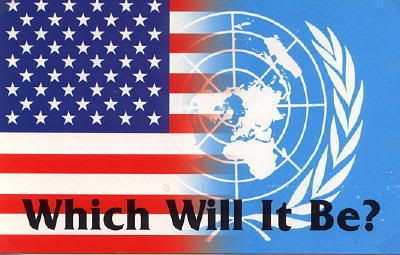
Showing posts with label global governance. Show all posts

Friday, June 6, 2008

Czech President Vaclav Klaus Has Long Warned Against Global 'Europeanism': But is the 110th U.S. Congress Listening? Does it Want This for America??

http://www.brusselsjournal.com/node/206

Czech President Warns Against “Europeanism”


From the desk of Paul Belien


The Brussels Journal


August 28, 2005


The most impressive speech during the recent Regional Meeting of the Mont Pelerin Society was undoubtedly Czech President Václav Klaus’s “View from a Post-Communist Country in a Predominantly Post-Democratic Europe.” Klaus has been an MPS member since 1990 and likes to attend the MPS meetings. Though his political obligations (as Prime Minister from 1992 to 1997 and President since 2002) do not always allow him to attend, he combined his presence at the MPS meeting in Reykjavik with an official visit to the Republic of Iceland.


Václav Klaus President Klaus spoke last Monday, warning for the new “substitute ideologies of socialism” such as “Europeanism” and “NGOism.” These “isms” are currently threatening Europe. “In the first decade of the 21st century we should not concentrate exclusively on socialism,” he said.


“There is a well-known saying that we should not fight the old, already non-existent battles. I find this point worth stressing even if I do not want to say that socialism is definitely over. There are, I believe, at least two arguments, which justify looking at other ideologies as well. The first is the difference between the hard and soft version of socialism and the second is the emergence of new ‘isms’ based on similar illiberal or antiliberal views.”


Václav Klaus is an indomitable defender of liberty, Europe’s only leader in the mould of the formidable Lady Thatcher. Though communism, the “hard version of socialism” is probably over this has not automatically led “to a system we would like to have and live in,” he said.


“Fifteen years after the collapse of communism. I am afraid more than at the beginning of its softer (or weaker) version, of social-democratism, which has become – under different names, e.g. the welfare state or the soziale Marktwirtschaft – the dominant model of the economic and social system of current Western civilization. It is based on big and patronizing government, on extensive regulating of human behavior, and on large-scale income redistribution.”


[See, e.g., V. I. Lenin, Two Tactics of Social-Democracy in the Democratic Revolution, (Foreign Languages Press, Peking (c) 1965), at: http://images.google.com/imgres?imgurl=http://www.marx2mao.com/Lenin/L97p(249x312).GIF&imgrefurl=http://www.marx2mao.com/Lenin/TT05.html&h=312&w=249&sz=9&hl=en&start=3&tbnid=MyVOy8MeAhq96M:&tbnh=117&tbnw=93&prev=/images%3Fq%3Dsocial%2Bdemocratism%26gbv%3D2%26hl%3Den%26safe%3Doff ].


He urged the MPS members and all freedom loving Europeans “to understand this contemporary version of world-wide socialism, because our old concepts may omit some of the crucial features of what is around us just now. We may even find out that the continuous use of the term socialism can be misleading.”


“Illiberal ideas are becoming to be formulated, spread and preached under the name of ideologies or “isms”, which have – at least formally and nominally – nothing in common with the old-style, explicit socialism. These ideas are, however, in many respects similar to it. There is always a limiting (or constraining) of human freedom, there is always ambitious social engineering, there is always an immodest ‘enforcement of a good’ by those who are anointed (T. Sowell) on others against their will, there is always the crowding out of standard democratic methods by alternative political procedures, and there is always the feeling of superiority of intellectuals and of their ambitions.”


As substitutes of socialism, Václav Klaus cited “environmentalism (with its Earth First, not Freedom First principle), radical humanrightism (based – as de Jasay precisely argues – on not distinguishing rights and rightism), the ideology of ‘civic society’ (or communitarism), which is nothing less than one version of post-Marxist collectivism which wants privileges for organized groups, and in consequence, a refeudalization of society […], multiculturalism, feminism, apolitical technocratism (based on the resentment against politics and politicians), internationalism (and especially its European variant called Europeanism) and a rapidly growing phenomenon I call NGOism.”


“These alternative ideologies […] are successful especially where there is no sufficient resistance to them, where they find a fertile soil for their flourishing, where they find a country (or the whole continent) where freedom (and free markets) have been heavily undermined by long lasting collectivistic dreams and experiences and where intellectuals have succeeded in getting and maintaining a very strong voice and social status. I have in mind, of course, rather Europe, than America.


[BUT, FOLLOWING THE NOVEMBER 2006 U.S. CONGRESSIONAL ELECTIONS, IT WOULD APPEAR THAT AMERICA, AS WELL, UNDER DEMOCRATIC PARTY RULE, EMBRACES 'EUROPEANISM' AND 'SOFT SOCIALISM']


It is Europe where we witness the crowding out of democracy by post democracy, where the EU dominance replaces democratic arrangements in the EU member countries, where [some people] do not see the dangers of empty Europeanism and of a deep (and ever deeper) but only bureaucratic unification of the whole European continent. They applaud the growing formal opening of the continent, but do not see that the elimination of some of the borders without actual liberalization of human activities ‘only’ shifts governments upwards, which means to the level where there is no democratic accountability and where the decisions are made by politicians appointed by politicians, not elected by citizens in free elections.


The European constitution was an attempt to set up and consolidate such a system in a legal form. It was an attempt to constitute it. It is, hence, more than important that the French and Dutch referenda made an end to it, that they interrupted the seemingly irreversible process towards an ‘ever-closer Europe’.”


Václav Klaus called for a European political system not to be “destroyed by a postmodern interpretation of human rights with its stress on positive rights, with its dominance of group rights and entitlements over individual rights and responsibilities, and with its denationalization of citizenship.” He explicitly opposed the “weakening of democratic institutions, which have irreplaceable roots exclusively on the territory of the states,” as well as “the ‘multiculturally’ caused loss of a needed coherence of various social entities” and the “continental-wide rent-seeking made possible when decision-making is done at a level which is very far from the individual citizens and where the dispersed voters are even more dispersed than in sovereign countries.”


He also opposed “excessive government regulation” and “huge subsidies to privileged or protected industries and firms.” He warned that Europe’s social system “must not be wrecked by all imaginable kinds of disincentives, by more than generous welfare payments, by large scale redistribution, by many forms of government paternalism.” Instead, Europe has to “be based on freedom, personal responsibility, individualism, natural caring for others and genuine moral conduct of life.”


“[Europe] is a system of relations and relationships of individual countries, which must not be based on false internationalism, on supranational organizations and on misunderstanding of globalization and of externalities, but which will be based on good neighborliness of free, sovereign countries and on international pacts and agreements.”


President Klaus’s speech was spot on. One rarely hears a politician outlining in such poignant and clear words the problems of our times that others dare not mention out of fear of being “politically incorrect.” It reminded us of Margaret Thatcher’s seminal “Bruges Speech” on 20 September 1988.


Mr. Klaus’s Reykjavik MPS speech of 22 August can be found in full on his website. The Brussels Journal has recorded the speech on audiotape from within the conference room. It can be downloaded here (see "attachments" at the bottom of this article).

Saturday, April 19, 2008

If Gordon Brown Insists that the US Buy Into Global Governance, Then This Can Only Be Done at American Constitutional Standards

http://usvisit.pm.gov.uk/2008/04/18/keynote-foreign-policy-speech

http://video.aol.com/video-detail/british-pm-browns-speech-at-the-jfk-library/2454956070 (video of Gordon Brown’s Speech)


Keynote foreign policy speech


Friday 1:09 pm (BST-5) Boston


This is the full text of the Prime Minister’s Kennedy Memorial lecture.


Kennedy Memorial lecture


The Rt Hon Gordon Brown MP


Prime Minister of the United Kingdom


18th April 2008


It is a great privilege to be here in Massachusetts, in Boston, and to be present with such distinguished guests in this library where history comes alive and values endure.


And a privilege too to be introduced by Senator Kennedy —– and I cannot speak too highly of the legislative record of Senator Kennedy who has served in the Senate for almost a quarter of the Republic’s life, earned his place as one of the greatest Senators in more than two centuries, and for its record of public service the Kennedy family is respected and renowned not just in this continent but in every continent of the world.


In the years since John F Kennedy’s Presidency:


· man has walked on the surface of the moon - directly as a result of his commitment, made on 25th May 1961;
· the Berlin Wall that he so famously denounced has been reduced to rubble – the Cold War ended, freeing eastern Europe, and making Europe whole again;
· and Nelson Mandela has walked free and apartheid – which John Kennedy denounced as ‘repugnant’ – has been swept away.


Great events, once the vision of one man - now landmarks in the history of the world.


And although he was President for less than three years I believe that the much of the progress of this half century has been testament to the scope of John Kennedy’s dream, the worth of the ideals he lived for, the breadth of hope he inspired in us, and most of all - amid all the wit, style, elegance and statesmanship that adorned the Kennedy Presidency - his summons to service —- one that never fails to inspire people to see farther and reach higher, a call which still reverberates around the world and always will. And his influence for good is so powerful that as Pericles said in ancient times even when he has left this world his influence ‘abides everywhere…woven into the stuff of other men’s lives’.


And although it is perhaps risky for a British Prime Minister to come to speak in Boston shortly before Patriots Day, I am pleased that over the past half century the special relationship between America and Britain which John Kennedy prized remains strong and enduring —- so firmly rooted in our common history, our shared values and in the hearts and minds of our people that no power on earth can drive us apart.

Nothing in President Kennedy’s enduring legacy has greater importance now - at the beginning of the 21st century - than his words on your Independence Day in 1962 when he proposed a new and global declaration of interdependence.


‘Today Americans must learn to think inter-continentally’ he said. ‘Acting alone by ourselves [America] cannot establish justice throughout the world. We cannot ensure America’s domestic tranquillity; provide for its common defence; or promote its general welfare; or secure the blessings of liberty to ourselves and our posterity. But joined with other free nations we can do all this and more’.


So if the 1776 Declaration of Independence stated a self evident truth - that we are all created equal – JFK’s Declaration of Interdependence in 1962 added another self-evident truth: that we are all of us - all of us throughout the world - in this together. Each of us our brother’s keeper, each of us - to quote Martin Luther King - part of an inescapable web of mutuality.


Yet no-one in 1962 could have foreseen the sheer scale of the new global challenges that our growing interdependence brings: their scale, their diversity and the speed with which they have emerged:


· the globalisation of the economy;
· the threat of climate change;
· the long struggle against international terrorism;
· the need to protect millions from violence and conflict and to face up to the international
consequences of poverty and inequality.


Challenges that all point in one direction – to the urgent necessity for global cooperation. For none of them - from economy to environment - can be solved without us finding new ways of working more closely together.


To recognize this is important. But simply to acknowledge that there are no ‘Britain-only’ or ‘Europe-only’ or ‘America-only’ solutions to the global threats and challenges we face - or to say we are all internationalists now - will change nothing in itself.


Instead, we must go much further: acknowledging that our common self-interest as nation states can be realised only by practical cooperation; that ‘responsible sovereignty’ means the acceptance of clear obligations as well as the assertion of rights.


And my argument today is simple:


· global problems require global solutions;


· the greatest of global challenges demands of us the boldest of global reforms;


· the most urgent of tests demand the broadest of global cooperation;


· and to address the worst evils of terrorism, poverty, environmental decay, disease and instability, we urgently need to step out of the mindset of competing interests and instead find common interests – summoning up the best instincts and efforts of humanity in a cooperative endeavour to build new international rules and institutions for the new global era.


[GORDON BROWN SETS FORTH THE MALTHUSIAN SOCIALIST'S 'TOP-TEN' LIST OF THREATS TRIGGER BY 'MARKET FAILURES' TO JUSTIFY A TOP-DOWN UN CENTRALIZED GLOBAL LEGAL, ECONOMIC & POLITICAL GOVERNANCE]


Let me sketch out the challenges we face, the new directions I favour and the solutions I propose.


[1] The first - and perhaps because of the credit crunch the most immediate - challenge is economic globalisation itself.


And does not the recent sharp and still unresolved credit crunch which has affected the whole world now demonstrate that with global flows of capital already replacing the old national flows and global sourcing of goods and services replacing the old local sourcing, national systems of supervision and economic management are simply inadequate to cope with the huge cross-continental flows of capital in this interdependent world?


But is not the issue even bigger than that? That we are seeing in the scale, scope and speed of globalisation the biggest restructuring of economic life since the industrial revolution. Already Asia is manufacturing more than Europe and soon America; China alone is producing half the world’s clothes and half the world’s electronics. And we are only at the beginning of this shifting balance of power as every day more and more of the 4 billion Asian people are entering the world’s industrial economy.


And the reality is that we are all affected now by what happens in Asia or Latin America or Africa. And if we do not work across countries and continents to create a globalisation that is inclusive for all, then not only will the poorest of the world who lose out react to being excluded, but people in our own countries will feel - as many do today - victims not beneficiaries of the process of change - losers and not winners - and protectionist sentiment will gain ground.


I am optimistic about the benefits of interdependence, and certain that globalisation need not be a zero sum game that says if China or India benefits America or Europe loses. Why? Because over the next 25 years we will see the world economy doubling in size, creating a billion new professional or skilled jobs worldwide, offering opportunity for any who have the creativity, ingenuity, skills and talent to benefit - a time of huge opportunity even if it is also a time of change and risk.


And in the spirit of John Kennedy who summoned us to think of how we can make our interdependence work for the benefit of all, I believe a new global deal is possible:


· in the industrial countries like ours a guarantee that even if we cannot keep people in their last job we can ensure people will be able to obtain the next job - through investment in skills and income support wherever necessary;


· and in the poorest countries a new deal that in return for opening up to trade, freeing regimes from corruption and a commitment to economic growth, we support the development of education, infrastructure and healthcare.


And the benefits will flow most widely and more effectively if instead of trying to pursue beggar-my-neighbour policies, or erecting national barriers to shelter people from change, we cooperate across frontiers to maximise the opportunities. But to do this we have no choice now – and his is my main argument - but to consider and agree new global rules and create new global institutions so that not some but all can benefit from change.


[2] And how do we face up to the second great global challenge? — that of climate change which is already creating the first climate change droughts, the first climate change evacuations, the first climate change refugees?


It is this challenge that starkly defines the most basic truth of our human condition: that, if as far ahead as we can foresee, there is no other planet for us and our children - we must cooperate to make our stewardship of this earth work.


So it will not be enough to discuss purely national initiatives or even to quarrel over the burden of sharing emission reductions while global warming continues unchecked. Because global problems cannot be solved without global solutions we need to join together in recognising that cooperation in an interdependent world means a single framework for global and national targets, and for the first time a truly global carbon market.


[PROOF THAT PROPONENTS OF TOP-DOWN UNITED NATIONS-CENTRED GLOBAL GOVERNANCE ARE USING THE ISSUE OF CLIMATE CHANGE TO CALL FOR NEW STRINGENT NON-SCIENCE AND NON-ECONOMICS-BASED PRECAUTIONARY PRINCIPLE REGULATIONS THAT WOULD REACH INTO THE UNITED STATES HEARTLAND AND RESHAPE, 'RENEW' AND 'CHANGE' ITS UNIQUE, INDIVIDUAL-BASED CONSTITUTIONAL LEGAL AND FREE MARKET ECONOMIC SYSTEMS SO THAT THEY MORE CLOSELY RESEMBLE EUROPE'S COMMUNITARIAN NAPOLEONIC CODE, WHICH TELLS PEOPLE WHAT THEY CAN AND CANNOT DO FOR THE SAKE OF THE COMMON GOOD.]


[3] A third force of globalisation is the sobering reality that has already struck home in both Britain and America: that we are exposed - unpredictably but directly - to the risk of violence and instability originating in failed and rogue states around the world. Once we feared rival nations becoming too strong; now the worst threats come from states that are too weak. And we know that the richest citizen in the richest country can be directly affected by what happens to the poorest citizen in the poorest country.


So today no country can say that failed or failing states are someone else’s problem. They are a problem for us all. Instability in one country affects stability in all countries; an injustice anywhere is now a threat to justice everywhere. And that is how we must respond: not walking away as we did in Rwanda at the cost of hundreds of thousands of lives, but by engaging as hard-headed internationalists - through diplomatic, economic, and yes when necessary military action - to prevent crimes against humanity when states can no longer do so.


Linked to failed and failing states is the spread of international terrorism, in the form of loosely affiliated global networks that threaten us and other nations across oceans and continents — and let me praise President Bush for leading the world in our determination to root out terrorism and our common commitment that there be no safe haven for terrorists.


Where once we imagined that nuclear or biological weapons were a state monopoly, now there is the prospect of hidden unofficial arsenals in the hands of terrorists. And to counter such threats effectively we must work together across national borders.


We will at all times be steadfast and resolute against terrorism at home and abroad using all our resources - military, security, policing, intelligence – to expose and defeat terrorists. And vitally in this struggle we must mobilise the power of ideas, of shared values and of hopes that can win over hearts and minds.


Just as importantly, we must recognize that our enemy, as George Marshall put it in a great speech in Boston sixty years ago, will never be just one country but ‘hunger, poverty, desperation, and chaos’. And while today many millions live well, we have 2.5 billion neighbours who subsist on less than 2 dollars a day: a fact that demonstrates what Winston Churchill once called ‘the gaping sorrows of the left out millions’.


And ours is already a world where no ‘us’ - however rich or influential - can pull up the drawbridge in an attempt to gain protection from a ‘them’


New contagious diseases can advance swiftly from the national to the global with all the speed of international air travel.


And as global transport networks and global communications erode or abolish traditional frontiers, national crime all too readily becomes international crime.


So global neighbours are closer than ever before - and we to them. And the critical question is this: how we plan and act together across continents to tackle disease, crime, mass migration and mass poverty?


And we must recognise too that our interdependence in the economy, environment, security, poverty, disease and crime is now underpinned by the truly revolutionary impact of advancing technology whereby a device on a desk or in the palm of our hand puts us in contact with anyone, anywhere, anytime. It is a revolution that is rewiring, multiplying and accelerating social, economic, and political connections within and between our nations, to their total and irreversible transformation. A revolution which potentially transforms democratic life and means the world can never be the same again.

[THIS IS A NUANCED REFERENCE TO THE NEED FOR OBAMA-TYPE 'CHANGE' WHICH LEAVES BEHIND AMERICANS' CONCEPTIONS OF INDIVIDUALISM, FREE MARKETS, AND U.S. CONSTITUTIONALLY GUARANTEED RIGHTS, ESPECIALLY TO PRIVATE PROPERTY. ONE NEED ONLY LOOK AT HOW GORDON BROWN IGNORED THE WISHES OF THE BRITISH PEOPLE TO HOLD A REFERENDUM ON THE REFORM EU CONSTITUTION/ TREATY - HE BASICALLY OVERRODE THEIR DUE PROCESS RIGHTS!! NOW HE & HIS EUROPEAN COLLEAGUES WANT THE AMERICAN DEMOCRATIC PARTY, SHOULD THEY SECURE THE U.S. PRESIDENCY, TO DO THE SAME - i.e., TO REINTERPRET OR OTHERWISE BURN THE CONSTITUTION IN FAVOR OF A NEW GLOBAL VISION/MISSION. AMERICANS HAVE A RIGHT TO KNOW WELL BEFORE THE PRESIDENTIAL ELECTIONS].


A few years ago in regime after regime sentries could stand over fax machines as governments sought to deny information to their peoples. Today - as we have seen in Burma - pictures of repression sent across the internet can alert the whole world; and - as we saw in the Philippines - one million people exchanging text messages on mobile phones brought down a country’s leader —- what was called the first ‘coup de text’.


So the dawn of the digital age is enabling people to become the authors of change rather than its subjects, the agents of history rather than its victims. And within a decade or two, it will create a virtual world of individuals speaking instantly across once virtually impassable distances, communities springing up across the internet, a rising sense of global consciousness of millions of global citizens in the making.


To adapt an aphorism of President Kennedy, the new frontier is that there is no frontier…


· no frontier for the internet, for the mobile phone, for e-mails, for the cyber-world;
· no frontier for the capacity of individuals to influence, inform or even infuriate each other.


And because times are new, we must - in Robert Kennedy’s words -think anew. We must, as he said, leave behind yesterday and embrace tomorrow.


So while in President Kennedy’s time foreign relations were founded almost exclusively on the relative power of governments, today we must recognise the relevance to foreign policy of what we see before our eyes:


· that everywhere around us people are forming global associations, global connections and global communities;

· that all over the world from culture to education to social action individuals are harnessing people power to transcend states – for good, and sometimes for ill;

· and they are compelling institutions and authorities to follow their example — with regulators, environmental and development agencies, militaries, law enforcement and judges all having to cooperate directly across frontiers.


As greater people power drives forward the creation of this new world order, foreign policy has increasingly to be explained daily to a questioning public who will increasingly also demand to know the basis on which we act.


And if in the 18th and 19th centuries nation states looked to the concept of the balance of power for their security - and in the latter half of the 20th briefly put their faith in the concept of mutually assured destruction - we, amid the emerging complexities of the 21st century, must recognize afresh the power of John Kennedy’s Declaration of Interdependence. And must firmly root our international system in the values we hold in common — shaping more than a new world order, creating instead a truly global society:


· a global society no longer just based on the power of states delineated by borders but on the aspirations of people that transcend borders;

· a global society no longer founded just on balancing competing interests but on building institutions that foster mutual interests because they are grounded in common values.


Indeed I would go further: in democracies such as ours - and now in a global society where people can communicate, lobby, petition and express and organize their views freely across continents - acting upon our interdependence demands that we found our cooperation and build alliances upon those enduring and humane values we share in common —– values that emphasise at all times the dignity and liberty of the individual, the indispensability of justice within and between nations, and our responsibilities as citizens of both our own nation and of the world.


Throughout history we have too often allowed ourselves to believe that the foreigner was at best a stranger and at worst an enemy; that across national borders our ethical values could be as different as our cuisine or fashion or language. In fact, the more we discover about each other the more we find how often we subscribe to similar ideals - regardless of geography, history or identity.


For through each of our diverse heritages there runs a single, powerful moral sense: one that is reflected and replicated throughout the world’s great religions and also in the moral philosophy of those who adhere to none that shows we are not moral strangers but there is a moral sense common to us all.


When Christians say: ‘do to others what you would have them do to you’;

When Muslims say: ‘no one of you is a believer until he desires for his brother that which he desires for himself’;

When Jews say ‘what is hateful to you, do not to your fellow man’;

When Hindus say ‘this is the sum of duty: do naught unto other which would cause pain if done to you’;

When Sikhs say ‘treat others as you would be treated yourself’;

When Buddhists say ‘hurt not others in ways that you yourself would find hurtful’;
….they reflect a common truth dear to billions of adherents of those and other religions that is true also of all the great secular thinkers: that we not only cooperate out of need but there is a human need to cooperate; and that cooperation is built on the desire for liberty and the call to justice: respect for the dignity of every individual and our sense of what is equitable and fair.


Call it as Lincoln did ‘the better angels of our nature’;

Call it as Winstanley did ‘the light in man’;

Call it ‘our moral sentiment’ as Adam Smith did;

Call it conscience;

Call it the moral sense;


it is on the basis of our common humanity and common values that that even people thousands of miles apart can share the pain of others and believe in something bigger than themselves. And it is for our generation to bring to life these shared values - which already have the capacity to unite people across the world - in proposals to create the architecture of a global society.


[THIS IS THE SAME AS THE 'COMMON HERITAGE OF MANKIND' DOCTRINE EMBEDDED IN THE UNITED NATIONS LAW OF THE SEA CONVENTION, WHICH ESTABLISHES A 'GLOBAL COMMONS' THAT IS TO BE REGULATED BY A TOP-DOWN, UNITED NATIONS-CENTRED BODY]


Acting upon our interdependence does not mean a new version of the old balance of power arrangements based on opposing powers bargaining for their own narrow advantage.


[THIS IS THE SAME THING AS SAYING THAT INDIVIDUAL PRIVATE PROPERTY RIGHTS SHOULD NO LONGER BE BASED ON THE NOTION OF 'NEGATIVE' RIGHTS, EXISTING IN OPPOSITION TO AND AS AGAINST BOTH THE SOVEREIGN AND OTHER PROPERTY OWNERS & CITIZENS, BUT RATHER ON THE NOTION OF 'POSITIVE' PROPERTY RIGHTS WHICH ARE GRANTED, SHAPED AND LIMITED BY THE SOVEREIGN FOR THE SAKE OF THE COMMUNITY - IN THIS CASE, NOT THE NATIONAL COMMUNITY, BUT THE GLOBAL COMMUNITY.]


But nor does it mean abandoning national interests. Instead, the very fact of interdependence requires nations to work out new ways of working founded on the recognition that they can best pursue their national interests by invoking broader global alliances – and that these global alliances must be grounded in shared global goals and globally agreed rules and institutions.


[OBVIOUSLY, MR. BROWN AND HIS FELLOW EUROPEAN SOCIALISTS ARE SENSITIVE TO THE ACCUSATION THAT THEY WISH TO DO AWAY WITH NATIONAL SOVEREIGNTY, BECAUSE THAT ARGUMENT CAN CAST A DEATH KNELL OVER THEIR GLOBAL GOVERNANCE PLANS - READERS MUST CAREFULLY SCRUTINIZE THE WORDS USED BY MR. BROWN AND HIS COLLEAGUES. AS THE FRENCH SAY, WHAT IS STATED IS IMPORTANT; BUT WHAT IS NOT STATED IS EVEN MORE IMPORTANT, BECAUSE ACCORDING TO FRENCH LOGIC, IF SOMETHING IS NOT STATED, IT IS PERMISSIBLE.]


There have been four great moments in the modern age when statesmen have come together to reorder the world:


· in 1648: in the Westphalia Treaty that followed Europe’s catastrophic Thirty Years War;
· in 1815: at the congress of Vienna after the Napoleonic wars;
· and twice in the last century: disastrously in 1919 at Versailles and - most significantly - in the late 1940s when, in a world wracked by total war, new global arrangements were agreed.


At that time - and in a breathtaking leap forward into a new world order – American visionaries helped form the United Nations, the World Bank, the International Monetary Fund; and they put in place a policy of unprecedented generosity - the Marshall Plan - which transferred 1 per cent of America’s national income each year for four years to the war ravaged economies of Europe —– and saved the free world.


[BUT AMERICAN VISIONARIES NEVER, NEVER INTENDED FOR THE U.S. TO SURRENDER IS NATIONAL CONSTITUTIONAL SOVEREIGNTY TO THE UNITED NATIONS!!]


Such was the impact of what they did for their day and age that Dean Acheson spoke of being ‘present at the creation’. And in a new era when the challenges of 2008 are different from those of 1945, we must summon inspiration from the vision, humanity and leadership shown by those reformers to guide our actions today.


And this is no longer an academic debate that can wait because change is too difficult to implement; or because we must consider at length what is to be done – with a view to doing nothing.


This is urgent. And the challenge is far reaching.


[MR. BROWN IS CORRECT IN SAYING THAT THE DISCUSSION ABOUT WHETHER THERE EXISTS AND SHOULD BE A MOVEMENT TOWARDS GLOBAL GOVERNANCE IS NO LONGER ACADEMIC - IT IS NOW OUT IN PUBLIC VIEW FOR ALL AMERICANS TO SEE. BUT, MR. BROWN IS INCORRECT IN SAYING THAT URGENT ACTION IS REQUIRED AND THAT DOING NOTHING IS NO LONGER ACCEPTABLE; RATHER, DOING NOTHING IS OFTEN THE BEST COURSE OF ACTION WHEN THE LEGAL, ECONOMIC & POLITICAL CONSEQUENCES OF DOING SOMETHING ARE UNCERTAIN, SWEEPING AND VERY EXPENSIVE. DEAR MR. BROWN, THE SUCCESS OR FAILURE OF THE EU EXPERIMENT IS STILL UNKNOWN, AND YET YOU AND YOUR FELLOW EUROCRATS INSIST THAT THE WORLD FOLLOW IN ITS PATH.]


The great Bostonian Emerson not only summed it up when he said: ‘what lies behind us and what lies before us are tiny matters compared to what lies within us’, but also warmed us of the radical consequences that follow: ‘do not go where the path may lead, go instead where there is no path and leave a trail’.


Those who build the present only in the image of the past will - in the words of Winston Churchill - miss out entirely on the opportunities of the future.


And when he warned of countries facing change who were too timid that they were ‘resolved to be irresolute, adamant for drift, solid for fluidity, all powerful to be impotent’, it is a powerful reminder of the need to act now.


First, a global society must embody and enact our obligations to each other not just within borders but across borders.


So I am proposing today reforms that will enable our international and regional institutions to do what they failed to do in the Rwandan genocide 15 years ago and are even now still failing to achieve amidst the tragedy of Darfur: to prevent conflict, to stabilise and then to reconstruct failing and failed states; and specifically to shield men, women and children who are being threatened by genocide, ethnic cleansing, war crimes or crimes against humanity. And so the United Nations must become a consistent defender of the interests of the world’s people – not simply those of states.


And this means new actions to prevent and respond to the breakdown of states and societies by:


· helping vulnerable nations develop the capacity to uphold the rule of law, by encouraging civil society, training police and security forces;


· more systematic use of earlier Security Council action including targeted sanctions and, as a last resort, the threat - and if necessary the use - of military force;

· new resources in the form of a UN crisis recovery fund to ensure proper financing for
stabilisation and reconstruction in countries emerging from conflict;

· and new encouragement for regional organisations from the African Union to the European Union to mount peace, stability and reconstruction efforts.


[PERHAPS MR. BROWN AND HIS EUROPEAN COLLEAGUES FEEL THE COLLECTIVE GUILT OF HAVING PILLAGED MOST OF THE AFRICAN SOCIETIES, THEY PREVIOUSLY HAD COLONIZED, HAVING LEFT THE AFRICAN PEOPLES WITH BARELY ANYTHING RESEMBLING A FREE, ENLIGHTENED AND DIGNIFIED EXISTENCE. IS MR. BROWN NOT RESTATING WHAT 19TH CENTURY REFERRED TO AS THE 'WHITE MAN'S BURDEN'???]


In 1960 President Kennedy called for an American peace corps - harnessing the idealism Americans felt in the face of deprivation and underdevelopment. Today in the same spirit we should create a new kind of global peace and reconstruction corps - an international stand-by capacity of trained civilian experts, ready to go anywhere at any time to help rebuild states.


Second, I favour strengthening the role of international institutions in ensuring a unified global response to terrorism - through asset freezes, travel bans, proscriptions, raising international legal standards, and unflagging resistance to extremist ideologies – measures led by President Bush as we discussed yesterday. But as he and I agree terrorism will ultimately be defeated only when it is isolated and abandoned.


So I propose a new cultural effort on the scale of the cultural Cold War in the ’40s, ’50s and ’60s: an initiative that involves foundations, charities, faith groups, elders and young people — and engages TV, radio, the internet and all forms of multimedia communication across all cultures, faiths and tongues to make the case for democracy and respect for human rights: how these offer the best future for us all; and how - in the face of these arguments - violent extremism is both unnecessary and wrong.


We will support interfaith dialogue in every part of the world. And with people power in a global society already advancing democracy widely across the world - from 20 per cent of nations being democratic in the early 1970s to 60 per cent today - we must encourage the development of the daily accountability, transparency and responsiveness and the civil societies which are at the heart of true democracies.


Third, a global society demands new global agreements and strengthened global institutions to protect and safeguard essential global resources.


So by the end of next year we must secure a new global climate change agreement – with the UN at its centre - with binding targets for all developed countries, including America and Britain. I want to see at least a halving of global emissions by 2050. And we need new incentives for developing and emerging economies - helping them slow their growth in emissions through new flows of finance and technology.


A global agreement is more than a set of targets: it must include an international carbon market as the surest and most efficient way to achieve our aims — eventually generating up to $100 billion dollars a year to fund ‘green’ development.


[UN-BROKERED, EU SUPPORTED CLIMATE CHANGE CHICANERY]


And while we strengthen the World Bank’s focus on poverty reduction, I have a radical proposal to make the World Bank a bank for development and the environment — transferring billions in loans and grants to encourage the poorest countries to adopt alternative sources of energy and in doing so ensuring that its development programmes provide an integrated approach to both poverty eradication and global warming.


We require a similar global coordination of effort on food where we face the worst food shortages for decades. And on disease and global pandemics where - led by the World Health Organisation - the priority is to improve early warning, increase the stocks of global vaccine supplies and develop a more coordinated global response. We need now to ensure there are clear responsibilities and decision-making procedures at every level. And Britain will bring together all interested parties to agree the new international action that is now essential to prevent pandemics and the spread of ill health.


Globalisation can work if it is an inclusive globalisation and protectionism can be avoided only by means of open economies, free trade and flexibility accompanied by policies for fairness and justice - policies that include investment in education and other social goods in the industrialised countries and a new deal for the poorest countries.


[MR. BROWN ALLUDES TO WEALTH-REDISTRIBUTION ORIENTATED TRADE AND TECHNOLOGY POLICIES THAT UNDERMINE U.S. SOVEREIGNTY, ECONOMIC & TECHNOLOGY COMPETITIVENESS, AND FURTHER DRAINS U.S. JOBS - EXCEPT THOSE RELATING TO AN INTERNATIONAL UN-BASED PEACE CORPS.]


And my proposal here is that we set new global rules for a new 21st century global economic system with:


· a global trade deal that benefits rich and poor countries alike;

· new international financial architecture and economic institutions that end the mismatch between global capital flows and only the national supervision of them — with the IMF an early warning system for the global economy, focused on crisis prevention rather than just crisis resolution;

· and a new deal as bold as the Marshall Plan of the 1940s between rich and poor under which as developing countries open up to trade, address corruption and pursue policies for economic development and developed countries agree to make available new resources so that we can say of this generation: the preventable diseases of TB, polio and malaria are eradicated and for the first time in our history every child enjoys education.


And let me just explain why it is so important. When I visited Abuja in Nigeria I found that side by side with a dilapidated school that we did not support enough was a madrassas where Al Qaeda inspired extremists were enticing children into their school offering free high standard schooling – so our offer of education for all is not just an education and economic policy for the developing world it is a defence and security policy for the developed world.


So a new World Bank; a new International Monetary Fund; a reformed and renewed United Nations mandated and resourced that is greater than the sum of its parts; strong regional organisations from the European Union to the African Union able to bring to a troubled world the humanitarian aid, peacekeeping and the support for stability and reconstruction that has been absent for too long — all built around a new global society founded on revitalised international rules and institutions, and grounded in the great values we share in common.


[MR. BROWN & HIS EUROCRAT/UN BUREAUCRAT COLLEAGUES WANT AMERICA TO KISS 'GOODBYE' ITS UNIQUE CONSTITUTION, WHICH PROTECTS INDIVIDUALISM, 'NEGATIVE' PRIVATE PROPERTY RIGHTS, FEDERALISM, BALANCE OF POWERS, GOVERNMENT ACCOUNTABILITY, DUE PROCESS OF LAW (INNOCENCE UNTIL PROVEN GUILTY), AND U.S. NATIONAL SOVEREIGNTY.]


And during the year to come I want this debate about change to become a global dialogue about renewal as we embark upon a task perhaps more ambitious than even the Bretton Woods Conference in 1944.


Already the Commonwealth of 53 nations has agreed to convene a task force on these issues, the first meeting in London in June.


[THE COMMONWEALTH OF NATIONS IS AN ASSOCIATION OF 53 INDEPENDENT SOVEREIGN STATES, MOST OF WHICH ARE FORMER BRITISH COLONIES. See:
The Commonwealth Secretariat, at: http://www.thecommonwealth.org/Internal/20596/about_us ].


Reform and renewal should feature on the G8 and EU agendas.


I welcome Harvard University’s interest in taking forward work on the proposals.
I suggest next year a series of international conferences and meetings to agree how to transform these ideas into real change.


And we must engage business, NGOs, faith groups and individuals from all nations and continents in these debates.


American leadership is and will be indispensable. And now is an opportunity for an historic effort in cooperation: a new dawn in collaborative action between America and Europe – a new commitment from Europe that I believe all European leaders can work with America to forge stronger transatlantic links. For I sense common ground between our two great continents in the urgent need for renewal and reform.


[THIS STATEMENT IS FOR OBVIOUS USE BY PRESIDENTIAL CANDIDATES CLINTON & OBAMA]


And I also sense that this is the moment to bring in China, India, South Africa, Mexico, Brazil and other emerging countries to the heart of this debate – offering a greater role with the G8, to offer them more say in the IMF and World Bank, and to reform the security council of the United Nations.


Today - as we face these new global challenges - the tantalizing possibilities of a world where, as John Kennedy put it, the strong are just, the weak secure and the peace preserved are matched only by the terrifying risks of us failing to seize this moment.


For the first time in human history we have the opportunity to come together around a global covenant, to reframe the international architecture and build the truly global society. So today my call is not just to the public purpose of this generation but to the idealism of this and the next generation.


[THIS IS AN ALL-OUT ATTEMPT TO APPEAL TO AMERICA'S YOUTH IN ORDER TO 'RE-PROGRAM' AND RE-ORIENTATE THEM AGAINST THE CONCEPT OF U.S. NATIONAL SOVEREIGNTY WHICH, ACCORDING TO EUROPEAN ELITES AND UN BUREAUCRATS, IS CONSIDERED AN IMPEDIMENT TO GLOBAL PEACE, PROSPERITY, MORALITY & CIVITAS, IN FAVOR OF GLOBAL GOVERNANCE.]


History is not destiny. It is the sum total of the choices of each generation — the record of the vision of those who imagined and could see a better future, and believed they could touch the stars.


And if the 19th century became known as the century of industrialisation and the 20th century became defined as the century of world wars, the 21st century can be the first progressive century in which we created the first truly global society.


Forty years ago this year amidst tragedy and grief America lost two towering visionaries - Martin Luther King in April and Robert Kennedy in June.


Both of them refused to accept that the way things are is the way things must be and the way things must stay;

Both of them were men of conscience and courage who turned history in the direction of our best hopes;

Both of them believed in essential truths that I am celebrating today - that peace and prosperity are indivisible, that prosperity to be sustained has to be shared; and believed too that the greatest of social changes are built on the strongest of ethical foundations.


And when today cynics dismiss as and impossible dream or naïve idealism proposals to create the institutions of a truly global society let us remind them that people used to think black civil rights a distant dream, the end of the cold war an impossible hope, the ending of apartheid in our generation the work of dreamers, debt relief for the poorest countries an unrealisable idea.


It is fitting that this library - standing at the edge of the sea - is shaped like a great sail. For those it memorialises, to paraphrase Robert Kennedy, truly did send forth ‘ripples of hope’ that continue to move across history as a mighty wave.


And so let us have confidence we can discover anew in ourselves the values we share in common, let us have confidence we can act upon John Kennedy’s declaration of interdependence, and let us have confidence we can create a global covenant across nations to make peace and prosperity real in our generation.

Gordon Brown Wants 'Next' Democratic President to Submit America's Unique Constitution and National Sovereignty to Global Governance (UN/EU) Override

http://news.bbc.co.uk/2/hi/uk_news/politics/7353824.stm


[READERS SHOULD NOTE THAT UK PRIME MINISTER GORDON BROWN HAS ALREADY GIVEN AWAY TO THE EUROPEAN UNION ANCHORED IN BRUSSELS, WITHOUT POPULAR DEMOCRATIC PUBLIC SUPPORT (e.g., A PUBLIC REFERENDUM) THE NATIONAL LEGAL, ECONOMIC AND POLITICAL SYSTEMS, AND THUS, THE NATIONAL SOVEREIGNTY, OF THE UNITED KINGDOM. NOW HE WANTS THE UNITED STATES TO DO THE SAME...]
See: UK Labor Party Willing to Give-Away Country's Sovereignty to EU; Does the US Democratic Party Wish to Do the Same for America??, at: http://itssdpathologicalcommunalism.blogspot.com/2008/04/uk-labor-party-willing-to-give-away.html


Prime Minister Gordon Brown has urged a "new dawn" in co-operation between Europe and the US

All European leaders could work with the US to forge "stronger transatlantic links", he said in a speech in Boston on the last day of his US trip.


He urged them to work together to reform institutions like the UN, World Bank and International Monetary Fund.


They needed reforming to meet modern challenges, he told an audience at the John F Kennedy Presidential Library.

The tantalising possibilities of a world where as John F Kennedy put it, the strong are just, the weak secure and the peace preserved are matched only by the terrifying risks of us failing to seize this moment


Gordon Brown


Mr Brown, who is said to be angry that his trip to the US has been overshadowed by rows at home over his tax reforms, wants the UN to become more effective in conflict prevention and resolution.


He also wants the IMF to develop as an early warning system to prevent problems like the global credit crunch and the World Bank to acquire a new environmental emphasis.


He said: "Now is an opportunity for an historic effort in co-operation; a new dawn in collaborative action between America and Europe - a new commitment from Europe that I believe all European leaders can work with America to forge stronger transatlantic links.

[THIS TALK OF STRENGTHENING TRANS-ATLANTIC LINKAGES IS NOTHING MORE THAN NUANCED CODE LANGUAGE SERVING AS A FALSE PRETENSE JUSTIFYING THE SURRENDER OF U.S. NATIONAL SOVEREIGNTY TO AN ELITIST, COMMUNITARIAN & UNACCOUNTABLE EU/UN GLOBAL LEGAL INFRASTRUCTURE & INSTITUTIONAL BUREAUCRACY OPERATING AT LESS THAN GUARANTEED U.S. CONSTITUTIONAL STANDARDS]


"For I sense common ground between our two great continents in the urgent need for renewal and reform."


'Truly global'


Continuing this theme, he called for "strong regional organisations, building up the African Union as we built up the European Union".


Gordon Brown called for global economic policies that benefit both rich and poor

[THE SHERIFF & TAX COLLECTOR OF DOWNING STREET, IN LONDON, ENGLAND, NOW WISHES TO HELP THE EU COMMISSION SHERIFFS & TAX COLLECTORS SPREAD THROUGHOUT THE STREETS OF BRUSSELS, BELGIUM TO ELEVATE THE UNITED NATIONS TO THE SHERIFFS & TAX COLLECTORS OF PALAIS DES NATIONS, IN GENEVA, SWITZERLAND, SO THAT THEY CAN ASSUME THE ROLE OF A GLOBAL ROBIN HOOD]


Ultimately, he called for established institutions to "bring to a troubled world the humanitarian and peacekeeping and the support for stability and reconstruction that has been absent for too long", all of which would be "built around the vision of a global society founded on revitalised international rules and institutions".


[THIS IS THE SUPERIOR MORAL, SENTIMENTAL AND POLITICALLY CORRECT JUSTIFICATION FOR TOP-DOWN CENTRALIZED GLOBAL GOVERNANCE - LEST ANYONE DISAGREES, THEY ARE LABELED REACTIONARIES, SOVEREIGNTISTS, OBSTRUCTIONISTS, RACISTS, FASCISTS, ETC. ]


He also said that emerging nations such as China, India, South Africa and Brazil should have a greater influence in organisations like the G8, the IMF and the World Bank.


We have the opportunity to come together around a global covenant [??]to reframe the international architecture


DEAR MR. BROWN, WE ALREADY HAVE A UN CHARTER AND THOUSANDS OF INTERNATIONAL TREATIES, DECLARATIONS, AND RESOLUTIONS THAT ALLEGEDLY GOVERN GLOBAL, CONDUCT - WHY DO WE NEED MORE LAWS, STANDARDS, REGULATIONS, AND PROSCRIPTIONS AT THE UN / EU LEVEL?? IS THIS WHAT EUROPEAN UNION REGION-DOMINATED NAPOLEONIC LAW TRULY REPRESENTS ELEVATED TO A GLOBAL LEVEL?? WHY THEN, SHOULD AMERICA, WITH ITS UNIQUE CONSTITUTIONAL SYSTEM, HARMONIZE WITH THE THE EU, IF EU, AND BY EXTENSION, THE UN SYSTEM YOU ENVISION, WOULD RECOGNIZE INDIVIDUAL FREEDOMS AT LESS THAN U.S. CONSTITUTIONAL STANDARDS??]


Gordon Brown


"Today - as we face these new global challenges - the tantalising possibilities of a world where as John F Kennedy put it, the strong are just, the weak secure and the peace preserved are matched only by the terrifying risks of us failing to seize this moment," he said.


"For the first time in human history we have the opportunity to come together around a global covenant to reframe the international architecture and build the truly global society."


[DEAR, DEAR MR. BROWN - THERE ARE ONLY THREE IMPORTANT COVENANTS: TO FAMILY, GOD & COUNTRY]


Mr Brown has met President Bush and the three presidential candidates, senators John McCain, Hillary Clinton and Barack Obama in private meetings during his three-day trip.


Tax protests


But it has been overshadowed in the US media by that of Pope Benedict XVI, and he is said to believe a row over his decision to abolish the lowest rate of income tax at home has been exaggerated by the UK media.


On Thursday he broke off from meetings to telephone Labour MP Angela Smith to persuade her not to quit as a ministerial aide over the issue.


Later Ms Smith issued a statement denying she was about to quit as a parliamentary aide to Treasury Chief Secretary Yvette Cooper.


But since then four more ministerial aides have joined protests at the abolition of the 10p tax rate - although none have threatened to resign.


In total more than 70 Labour MPs have signed one of three motions protesting about the tax move, which came into force this month
.

-------------------------------------------------------------------------------------------------
http://www.bostonherald.com/news/regional/general/view.bg?articleid=1087948


British prime minister calls for global ’interdependence’


By Associated Press


April 18, 2008


British Prime Minister Gordon Brown, in his first foreign policy address in the United States, called on the U.S. and Europe today to lead a new era of global "interdependence" aimed at solving international problems such as terrorism, poverty and climate change.

[IN OTHER WORDS, GORDON BROWN IS SERVING AS 'THE LEAD' FOR THE EUROPEAN COMMISSION IN PROMOTING WHAT IS NOTHING LESS THAN GLOBAL ONE-WORLDISM OR KUMBAYA, GO-ALONG-TO-GET-ALONG DIPLOMACY]


"We urgently need to step out of the mindset of competing interests and instead find our common interests, and we must summon up the best instincts and efforts of humanity in a cooperative effort to build new international rules and institutions for the new global era," Brown said in a speech to about 350 invited guests at the John F. Kennedy Presidential Library and Museum.


Brown cited Kennedy’s Independence Day speech in 1962, when the president proposed a "new and global declaration of interdependence." Brown said Kennedy’s call for public service "still reverberates around the world and always will."

[BUT, PRESIDENT KENNEDY PROMOTED NATIONAL PUBLIC SERVICE, NOT GLOBAL PUBLIC SERVICE - HE ASKED THAT THE CITIZENS OF THE WORLD ACT FOR THEIR OWN SAKE, AND THAT OF THEIR NATIONS, SO THAT THEY EACH COULD BENEFIT FROM WHAT WOULD EVENTUALLY CONSTITUTE FREEDOM GLOBALLY. GORDON BROWN, IN IS APPEAL FOR SUPRANATIONAL GLOBAL GOVERNANCE MISREADS WHAT PRESIDENT KENNEDY SAID. HERE IS THE ACTUAL QUOTATION:

"My fellow citizens of the world: ask not what America will do for you, but what together we can do for the freedom of man. Finally, whether you are citizens of America or citizens of the world, ask of us the same high standards of strength and sacrifice which we ask of you. With a good conscience our only sure reward, with history the final judge of our deeds, let us go forth to lead the land we love, asking His blessing and His help, but knowing that here on earth God's work must truly be our own."]


Noting Kennedy’s creation of the Peace Corps, Brown called for the creation of "a new kind of global peace and reconstruction corps," which he described as an organization of trained civilian experts available any time to rebuild states.

[DEAR MR. BROWN, THE UN ALREADY HAS THE 'BLUE HELMETS' AND WE ALL SEE HOW EFFECTIVE THEY ARE IN PREVENTING GLOBAL CONFLICTS, LET ALONE, IN KEEPING THE PEACE ONCE THE BATTLES HAVE BEEN WON...]


Brown also talked about U.S. leadership following World War II, include the Marshall Plan that funneled millions in economic aid and technical assistance to help rebuild Europe.


"We must summon inspiration from the vision, humanity and leadership shown by those reformers to guide our actions today," he said.


Brown reiterated his call for reform of the World Bank, International Monetary Fund and United Nations to give emerging countries such as China, India and Brazil more say in the international institutions.


He called on the World Bank to intensify programs to reduce poverty and said the institution should become a bank for both development and the environment by transferring billions in loans and grants to encourage the poorest countries to adopt alternative sources of energy.


[WHAT MR. BROWN REALLY MEANS IS TRANSFER/REDISTRIBUTION OF WEALTH, TECHNOLOGIES & KNOW-HOW AT CONCESSION-RATE OR ROYALTY-FREE PRICES]

The British leader, who has set a mandatory target in the U.K. to cut greenhouse gas emissions by 60 percent by 2050, insisted that a new global pact on reducing carbon emission must be agreed on by the end of 2009.


He said the deal, which would replace the Kyoto Protocol that was rejected by the U.S. and expires in 2012, should be led by the United Nations and needs to set binding targets for all developed countries.


[MR. BROWN SHOWS HIS TRUE COLORS HERE - TOP-DOWN CENTRALIZED UN-BASED GLOBAL GOVERNANCE OF THE ENVIRONMENT, AND ALONG WITH IT, ALL ECONOMIC ACTIVITIES AROUND THE WORLD]


Brown, who has overseen some U.K. troop withdrawals in Iraq and sought to soothe public anger in Britain over the unpopular war, did not mention Iraq directly. But he insisted he would support future military action to intervene in failing states.


He praised President Bush for leading the world in an attempt to root out terrorism and "our common commitment that there be no safe haven for terrorists."


Brown said the United States and Europe should act as "hardheaded internationalists," and use "diplomatic, economic, and yes, when necessary military action _ to prevent crimes against humanity when states can no longer do so."


[MR. BROWN DENOUNCES U.S. HEGEMONY, BUT FAVORS US-EU JOINT HEGEMONY. HIS HE NOT BEING HYPOCRITICAL???]


-------------------------------------------------------------------------------------------------


http://www.telegraph.co.uk/money/main.jhtml?xml=/money/2008/04/19/ncrisis219.xml


Gordon Brown's US speech calls for new global finance rules


By Andrew Porter, Political Editor, in Boston


19/04/2008


An international early warning system should be established to ensure that future credit squeezes are identified and dealt with before the effects become widespread, says Gordon Brown.


In a foreign policy speech in Boston, the Prime Minister urged America to join him in pushing for reform of the major international institutions including the International Monetary Fund and World Bank.


At the end of his three-day trip to the US Mr Brown also said the world faced "terrifying risks" if countries "failed to seize the moment".

[MR. BROWN INTIMATES THE NUANCED MALTHUSIAN FEAR-BASED MANTRA OF SUSTAINABLE DEVELOPMENT, ENVIRONMENTAL ARMAGEDDON AND THE PREFERRED GLOBALIST SOLUTION: EUROPEAN STYLE, TOP-DOWN, UN CENTRALIZED, NON-SCIENCE & NON-ECONOMICS, PRECAUTIONARY PRINCIPLE-BASED REGULATIONS]

Mr Brown told an audience at the John F Kennedy Library that globalisation should combine free trade and open economies with policies promoting fairness and justice.


He said: "My proposal is that we set new global rules for a new 21st century global system with: a global trade deal that benefits rich and poor countries alike; a new international financial architecture and economic institutions that end the mismatch between global capital flows and only the national supervision of them - with the IMF an early warning system for the global economy, focused on crisis prevention rather than just crisis resolution."


Mr Brown has used his trip to meet Wall Street bankers to discuss the credit crunch. Yesterday, in Washington he met Ben Bernanke, the chairman of the Federal Reserve.


The two talked about what measures can be taken to alleviate the effects of the economic downturn. Next week, the Treasury is expected to announce measures to get the mortgage companies lending again, including taking on some debt in exchange for the lenders' co-operation with market liquidity.


Mr Brown also wants a reformed United Nations that is more effective and relevant to the 21st century that will give greater leadership and can give better assistance to poorer countries.


He told the audience, which included Senator Edward Kennedy: "During the year to come I want this debate about change to become a global dialogue about renewal as we embark upon a task perhaps more ambitious than even the Bretton Woods Conference in 1944 [which established international monetary rules]."


He added: "American leadership will be indispensable."

Saturday, April 5, 2008

German Fascism Principles Long Used by Enviro-Groups in Effort to Change US Laws & Deprive American Landowners of Their Private Property Rights

http://www.fee.org/publications/the-freeman/article.asp?aid=3647


Eco-Fascism


The Freeman: Ideas on Liberty - April 1995


By Russell Madden, Instructor in Communication at Mt. Mercy College in Cedar Rapids, Iowa


[READERS SHOULD WELL CONSIDER HOW & WHY THIS MOVEMENT HAS ENDURED AS LONG AS IT HAS - IT HAS RECEIVED BACKDOOR SUPPORT FROM THE LIBERAL POLITICAL ESTABLISHMENT - PREVIOUSLY, FROM THE (BILL) CLINTON ADMINISTRATION DURING THE 1990'S AND PROSPECTIVELY, FROM BOTH THE (HILLARY CLINTON AND BARACK OBAMA PRESIDENTIAL CAMPAIGNS), AND ALSO THE EUROPEAN COMMISSION WHICH IS 'DISCRETELY' TRYING TO INFLUENCE U.S. PUBLIC OPINION ABOUT ENVIRONMENTAL ISSUES, AND THROUGH THEM, THE OUTCOME OF THE 2008 PRESIDENTIAL ELECTIONS]


The violations of private property rights that have flowed from the environmental movement and its adherence to the erroneous theory of "intrinsic value" have already caused intense hardships for many people. Individuals have been prevented from developing their land as they best see fit because of claims by environmentalists that such usage would threaten an endangered species, a coastline, a wetland, or the general "character" of some landscape. The contention is that efforts to enjoy the benefits of these properties would destroy the value which that land or animal or plant supposedly possesses by its mere existence regardless of its relationship to specific human beings.


Unfortunately, as the old saying goes, "You ain't seen nothin' yet."


Generally, owners are allowed to retain title to the property under question but are prohibited from altering it in any way which does not follow some (usually ambiguous and frequently self-contradictory) governmental law or regulation. While they suddenly find themselves denied any say in what to do with that land, these hapless owners are still permitted the privilege of paying taxes on the property in question. This type of titular ownership devoid of control fits the definition of that economic/ political system known as fascism.


Given their successes in gaining governmental control over many disparate pieces of private property situated near so-called "ecologically sensitive" areas, the advocates of environmental fascism have gained confidence and grown bolder. They are now advocating a move that takes the environmental movement from a practice of petty theft to grand larceny on a breathtaking scale. The more radical practitioners of the theory of intrinsic value are no longer satisfied with the passage of laws that prevent the removal of a tree, the building of a fence or house, or the dumping of a few loads of dirt without permission. Their new Holy Grail is to create millions of acres of wilderness zones that will not merely regulate human usage, but will prevent anyone from venturing into such areas for even esthetic enjoyment. It is the intrinsic theory of value taken to its ultimate conclusion: the total elimination of human beings.


The Wildlands Project


The North American Wilderness Recovery (Wildlands) Project suggested by the Earth First! movement and its founder, Dave Foreman, proposes a violation of property rights which is so outrageous that many people might be tempted to dismiss it out of hand.[1] It would be easy to assume from its ludicrous provisions that the Wildlands Project would stand no realistic chance of passage; that defenders of private property could easily ignore it and devote their efforts to other concerns.


Yet fifty years ago, who would have supposed it credible that a snail, an owl, or a tree on one's own land would become excuses for the ecological fascism that has already spread its tentacles not only into American society, but throughout the entire world? The micro-management of land usage we have witnessed in the past thirty years now aspires to "macro-management" of the entire continent.


In these wilderness preserves, all evidence of humanity would be erased. All dwellings, the roads that link them together, the power lines that feed them, and any and all other man-made constructs would be removed and destroyed. Plants and animals—not people—would become the definers of value and usage. The needs, interests, or desires of human beings would be ruthlessly excised from any "ecological" decisions by the central planners of this ecological fascism. People would become subordinate to lower life forms in a crazy flip-flop of values and priorities. The needs of other species-not the protection of human rights-would become the new basis and rationale for politics if those who accept the credo of Earth First! have their way.


This movement becomes less a wild-eyed-pie-in-the-sky and more of a scary potential reality when you realize that other-wise reputable scientists support the general premise if not the specific details of such widespread preservation attempts. John Robinson, a biologist with the Wildlife Conservation Society, believes preservation should be done on a "landscape level." Another biologist from Oregon, Reed Noss, suggests that conservation must be practiced on a scale large enough to include not only endangered animals or plants, but also supporting flora and fauna and entire ecosystems in which natural selection and adaptation can occur.


New Endangered Species: Man


The logical conclusion of such premises is the removal of human beings from the entire earth, the largest ecosystem that exists. Then and only then would "Gaia" be restored to health.


While the eco-fascists have not yet announced such a far-reaching target, according to Michael Soule, creator of the Wilderness Project, they are unconcerned with "the limitations of time and space." They are committed if necessary to a centuries-long endeavor to restore much of North America to its pristine condition before the advent of humans altered these landscapes. Noss would like to see "at least half of the land area of the coterminous states" (emphasis added) included in this "hands off" zone. Additionally, these zones would be bordered by buffers in which only limited human activity would be allowed. Eventually, land occupied by people would exist only as isolated pockets within the greater wilderness areas.


Spokesmen for such groups as the Society for Conservation Biology, The Wilderness Society, Defenders of Wildlife, and even members of the U.S. Fish and Wildlife Service offer support for the general idea of the Wilderness Project. Peter Brussard from the University of Nevada at Reno believes that the Project "certainly is justifiable scientifically." Luckily, not a biologists accept that position; Deborah Jensen, a biologist with The Nature Conservancy, does not believe that the goal of conserving biodiversity requires such an approach as the Wilderness Project.


Even if those touting the Wilderness Project do not believe it possible to create such a massive preserve in one fell swoop, they may yet achieve their final goal piecemeal. Efforts are currently underway to set aside 139,000 square miles in the Great Plains for a buffalo sanctuary; the Paseo Pantera project seeks to connect wilderness areas in Central America; British Columbia is linking a new 4,000-square-mile park with Alaska and the Yukon Territory to create a 33,000-square-mile preserve; Congress is considering setting aside 11,000 square miles in California; the Nevada Biodiversity Project seeks to set aside hundreds of square miles of mountains; and Noss recently received $150,000 from the Pew Charitable Funds to further planning for wildlands set-asides.


In response to this proposal, some people were rightfully outraged.[2] One woman from Nevada said that, "Proponents of the project are incredibly insensitive to the values, freedoms, and property rights of the many millions of people who live in and love" these lands. She characterized these ecologists as "an arrogant urban elite with a compulsion to live out their fantasy at our expense" (italics in original—which is a remarkably accurate description of statists of any stripe.


Another man from Arizona stated that this idea "illustrates all the absurd flaws in the ecocentric mind—... that balanced ecosystems don't include humans, [and] that government coercion can override human nature." Absurd, yes ... but no more so than might describe the mind-sets of Marx or Lenin. Unfortunately, the "absurd flaws" of their political system did not prevent them from imposing it across a significant fraction of the globe over a seventy year time span. The idea of the Wilderness Project is still relatively new and controversial, yet its supporters may become powerful beyond any rational expectations.


Some of those advocates believe it is important to "halt the spread of nature's most dangerous predator and competitor"; that lands should be cared for by people "who wish to restore themselves to a natural (i.e., tribal) state"; that "27 representatives" and "over 50 scientists also support the Northern Rockies Ecosystem Protection Act."


Even if the Wildlands Project itself is not implemented, its very radicalism makes other, more subtle eco-fascist strategies seem reasonable. This kind of strategy has been used repeatedly in the environmental movement: push an outlandish policy then propose something even crazier so the first proposal appears rational in comparison. Given the plethora of environmental laws strangling our country and shredding our property rights, this approach has been an effective one.


As has been pointed out by other writers, collectivists and statists who have been unable to achieve the degree of control they desire over our society through economic arguments have shifted their plan of attack to a "moral" appeal based on the false premises of "intrinsic value," "animal rights," and the supposed imminent destruction of the very environment upon which we depend for survival.


A new coat of paint, however, does nothing to alter the essence of who these eco-fascists are and what they believe. As a song from the Sixties said, the new boss is the same as the old boss. The struggle against collectivism is far from over: it has merely shifted to a new playing field. And as do most collectivists, the eco-fascists say they want to do this to us "for our own good."


--------------------------------------------------------------------------------


1. Elizabeth Pennis, "Conservation's Ecocentrics," Science News. 9-11-93, pp. 168-170.

2. Science News, "Letters," 11-20-93, pp. 323, 334.

Sunday, March 9, 2008

Klaus Warns Americans: US Embrace Of Global Warming Alarmism Premised on Europe's Precautionary Principle Will Result In Sacrifice Of Liberty

http://online.wsj.com/article/SB120494352520121491.html?mod=opinion_main_commentaries


The Contrarian of Prague


By BRIAN M. CARNEY


March 8, 2008; Page A9


Wall Street Journal, New York


Being president of the Czech Republic is more like being England's monarch than the president of the United States. While the Czech president has veto power over certain types of legislation, his role is supposed to be mostly ceremonial.


But Vaclav Klaus -- who was re-elected last month after being chosen by the Czech Parliament as head of state in 2003 -- has not been content to confine himself to ribbon cuttings and state dinners.


Mr. Klaus has become a globally prominent voice of skepticism about what he calls global-warming "alarmism." This week, while in New York to address a gathering of fellow "non-alarmists" at a conference in Times Square, he took some time to sit down with members of the Journal's editorial board to offer his dissenting views on Russia, Kosovo, America and of course, climate change.


"I am not a climatologist," Mr. Klaus cheerfully admits. "I am not disputing the measurement of the temperature." Even so, Mr. Klaus believes that his many years of experience in the fields of economics and econometrics give him some insight into the nature of the problems faced by climatologists and policy makers. In climatology as in economics, he says, "there are no controlled experiments. . . . You can't repeat the time series." So, just as you can't run a controlled experiment to determine the effect of, say, deficits on interest rates, we can't directly determine the effect of CO2 on climate. All we have are observations and inferences.


Mr. Klaus is also interested in the politics of global warming. He has written a book, tentatively titled "Blue, Not Green Planet," published in Czech last year and due out in English translation in the U.S. this May. The main question of the book is in its subtitle: "What is in danger: climate or freedom?"


He likens global-warming alarmism to communism, which he experienced first-hand in Cold War Czechoslovakia, then a Soviet satellite. While the communists argued that we must all sacrifice some freedom in pursuit of "equality," the "warmists," as Mr. Klaus calls them, want us to sacrifice liberty -- especially economic liberty -- to prevent a change in climate. In both cases, in Mr. Klaus's view, the costs of achieving the goal, and the impossibility of truly doing so, argue strongly against paying a price of freedom.


Furthermore, the fact that there has been some warming over so many years does not, by itself, prove to him that this trend will continue indefinitely. "Undoubtedly there is some warming," Mr. Klaus allows. "But there has never been no change in climate, no change in global temperatures."


The world, he argues, is full of risks, and the risk of catastrophic climate change is just one of them. Therefore, we need a more measured approach to assessing the risks and the costs of mitigating them.


Cost-benefit analysis and the precautionary principle "are two different methodologies, two different
approaches, two different ways of thinking," he says.
The less desirable precautionary principle "as used by Al Gore and all his fellow travelers" says that "if you are afraid that there are risks to something, you may prohibit everything." He continues: "This is for me
absolutely unacceptable to think about."


Mr. Klaus's contrarian streak is not confined to climate change. He has been one of the few politicians in the European Union to publicly express doubts about the wisdom of recognizing Kosovo's recently declared independence from Serbia.


He fears that Kosovo's independence "will be a very good example for other parts of countries that are not happy with what is going on around them. A domino effect -- let's put it that way. So this is for me a very, very serious issue." He declines to be drawn out on specific examples of regions in Europe that could be emboldened to follow Kosovo's lead -- but it does not take much imagination to guess.


The Czech Republic has a sizable Hungarian minority that has been a periodic source of tension with its neighbor to the south for decades. Czechoslovakia, of course, also had its own unhappy experience with its German minority in the Sudetenland in the 1930s.


Even so, Mr. Klaus, steadfastly keeping to the level of generalities and hypotheticals, says: "I am . . . afraid that there are some countries where it's just the opposite -- a bigger country has a minority somewhere and wants to create a bigger original 'mother country' as it's sometimes called. And that's for me a problem because that could destabilize the situation in Europe."


When it comes to hosting American missile-defense facilities, Mr. Klaus's position is contrary to the dominant view in Europe. Opposition to the radar facilities is, in his view, nothing more than old-fashioned anti-Americanism.


"Some 'Old European' countries," Mr. Klaus says, pointedly borrowing the Rumsfeldian formulation that caused so much angst on the continent earlier in the decade, "take [the installation of the facilities] as our way of saying we are not just locked in Europe. We want to stand on two legs. One of them is the European and the other is trans-Atlantic. And they feel that this is our motivation, not Iran, not North Korea. . . . It's just that simple." For his part, "I want to have close ties with [the U.S.]," which is why he supports the bases.


Perhaps the most surprising and counterintuitive position he took during our meeting concerned Russia. The former Soviet satellites in Central Europe are often thought of as reliable skeptics of Russian intentions. But Mr. Klaus expresses a more sanguine view, even arguing that Western fears about Russia and Vladimir Putin are misplaced.


"I was one who always rejected the high-brow approach, [which says], 'Well, it's not good that they're not doing as well as some other countries in Central Europe.' That's a cheap criticism that I don't accept." So, does he not think that, through its supply of arms to Syria and Iran, and its obstructionism over Iran at the U.N. Security Council, Russia is once again picking a fight with the U.S. -- or at least in danger of doing so?


His response is at turns heated and pleading: "No one is thinking about that in Russia. Why do you think that's the way [they think]? Simply, Russia was totally lost and pushed to the floor and simply wants to be a normal country again. Don't interpret all the attempts to be accepted as a normal country as an aggressive position vis-à-vis the United States. This is not that way. I'm afraid that this is the mantra in the American newspapers but please, please, think about it twice because this is a tragic mistake."


What about the danger that Russia could use its role in supplying oil and gas to the rest of Europe as a weapon against EU economies? Again, the response is passionate: "I don't see it. This is for me . . . cheap, cheap headlining to say that, really. I live in a country where we are totally dependent -- we used to be totally dependent on Russian oil and gas. In my life, and I will be 67 this June, it has never happened for one minute that there has been cutting of deliveries of oil and gas. Please don't -- don't -- exaggerate that point. It's such cheap writing. Don't do it."


It's a strange moment. Here is a man who built his political career on his reputation for leading post-communist Czechoslovakia out of its socialist past, and who by his own account was banished into a kind of internal exile for championing liberalization ahead of the Warsaw Pact invasion of his country in 1968. Now he is urging his listeners to give Moscow the benefit of the doubt.


And yet when pressed, he pleads sudden ignorance of the country whose intentions he has just been defending. "You know, I am not an expert on Russia. You know more about it."


That seemed to end the matter, so we tried to return to global warming. But he interrupts to add a final thought on Russia: "Russia is more free now than in any time in its 2,000 years of history. So to speak about dictatorship is misusing the terminology, devaluing the terms that we use. This is something we should not say."


This is not to say everything is sunshine in Russia. "They are much less free than the Americans and the Czechs would accept. . . . Let's be clear about this. Is that clear?


"For me it is unacceptable to have such a relatively closed political system. Personally unacceptable, and being in Russia I would fight against it. But that's a different story than speaking of a dictatorship or not putting it in a proper historical perspective."


He goes on. "To say 'dictatorship' or to speak about Putin as the 'KGB man,' I would be [embarrassed] to use such a term. That is maybe for some boulevard journalist, but this is definitely much more complicated. Putin is a much more complicated and structured personality than just the 'KGB man.' And I'm sure you know it."


But here his account took an inexplicable turn. Mr. Klaus, by his own description "no expert" on Russia, points to "a growing decentralization in the country. The role of the individual regions and those governors, they create a different style of thinking and I see an evolution in Russia."


These are the same governors that, formerly directly elected, are now appointed by Mr. Putin himself, which hardly seems a recipe either for decentralization or independence from Moscow. Even so, Mr. Klaus argues that "to be blind . . . to the real changes that have been going on there probably would be a mistake."


In Europe, Mr. Klaus has the reputation of a firebrand, if not a loose cannon. This is a president, after all, who calls global warming "alarmism" a "radical political project" based in a form of "Malthusianism" that is itself grounded on a "cynical approach [by] those who themselves are sufficiently well-off."


"It is not about climatology," he insists. "It is about freedom."
Mr. Klaus left his hosts with a clear idea of why he so infuriates his opponents. There's no doubt, either, that he enjoys his self-assigned role as a contrarian.